Friday, July 10, 2026

Argentina: The 1890 Revolution

The 1890 Revolution


The Revolution of the Park, also known as the Revolution of 1890, was a civic-military uprising in Argentina on July 26, 1890, led by the recently formed Civic Union, headed by Leandro Alem, Bartolomé Mitre, Aristóbulo del Valle, Bernardo de Irigoyen, Francisco Barroetaveña, and Lionel Laufi, among others. The revolution was defeated by the government, but nevertheless led to the resignation of President Miguel Juárez Celman and his replacement by Vice President Carlos Pellegrini.

In 1889, Argentina was in turmoil: a severe economic crisis had lasted for two years, causing a sharp drop in wages, unemployment, and a wave of strikes unprecedented in the country. The presidency of General Julio Argentino Roca (1880-1886) had been succeeded by that of his brother-in-law, Miguel Juárez Celman, whose government was characterized by accusations of corruption and authoritarianism. His opponents called his administration the Unicato.

On August 20, 1889, an article titled "Yourself, Youth! Rushing Towards Success," signed by Francisco Barroetaveña, appeared in the newspaper La Nación. It shook public opinion, particularly among young people, condemning the lack of moral principles and the support of certain young men for then-President Miguel Juárez Celman. The article stated: 

Amid this general misrule, or the reign of this disastrous regime, which suppresses the nation's legal life, replacing it with abuse and arbitrariness, the first electoral efforts for the future presidency are underway. It is assured that the current President will impose his chosen successor, for he possesses the gold, the concessions, and the necessary force to break malleable characters and suppress any insurrection." The article in La Nación led to the formation of a youth group around Barroetaveña, which, in turn, called a large rally on September 1, 1889, in the Florida Garden of Buenos Aires. There, it was established as the Civic Youth Union, with the aim of uniting the broad spectrum of opponents to the regime of Miguel Juárez Celman, supported by the ruling National Autonomist Party.  


Revolutionary barricade protecting the Artillery Park.


President Juárez Celman was very discredited in 1890.

On December 15, 1889, Lucas Perrón, president of the Civic Youth Union, inaugurated a civic club at the San Juan Evangelista parish in Buenos Aires, with a rally held at the Iris Theater. At the end of the event, the civic leaders were attacked with firearms by a paramilitary group sent by the government. The police present, far from arresting the attackers, violently repressed those attending the rally. The event caused widespread public outrage and is cited as the most immediate trigger of the revolution.[1]

Aristóbulo del Valle recounts that, a few days later, he, Leandro Alem, and Mariano Demaría decided to take up arms. The immediate reason was "to prevent hopeless submission to the Juárez regime."[2] Juan José Romero, Miguel Navarro Viola, and Manuel Ocampo joined the initial group. Around that time, General Manuel J. Campos, a military officer and a close confidant of Bartolomé Mitre, also arrived from Europe. Del Valle then decided to contact him to enlist him in the revolution and thus incorporate Mitre's movement. Campos's response was emphatic: " Count me in and let me know when the time is right."[2] Parallel to the secret contacts preparing the conspiracy, the Civic Youth Union, led by Barroetaveña, sought to broaden its base of popular support in the City of Buenos Aires by organizing a larger political party: the Civic Union. Its stated purpose was: "to form a large political coalition party that would prevail in the electoral struggles, or on the field of action, if the government officials violated the rights of the people through fraud or violence."[3] In January 1890, the economic crisis continued to worsen. Term obligations could not be paid, and a bank run ensued. Panic led merchants to raise prices on basic necessities, and the population was suddenly impoverished. Local elections were held on February 2, but virtually no one turned out to vote. The newspaper El Nacional ran the headline the following day: Leandro Alem, head of the revolution, appointed provisional president. Yesterday's elections will have an epitaph: here lies the right to vote.[4] Public discontent spread, and President Juárez Celman quickly became its scapegoat.


Francisco Barroetaveña called on the youth to form the Civic Union.


Leandro Alem, leader of the revolution, appointed provisional president.

On April 13, 1890, a massive rally was held to found the Civic Union. The call to action was signed by virtually all sectors opposed to the government through their leading representatives. Among those present were former president Bartolomé Mitre and his followers, of oligarchic conservative leanings, as well as Catholic leaders José Manuel Estrada and Pedro Goyena, who actively opposed the secularism of the ruling National Autonomist Party. The organizers included young figures like Juan B. Justo, who a few years later would found the Socialist Party of Argentina, and the lawyer Francisco Barroetaveña, who had mobilized progressive middle-class youth in Buenos Aires. But there was also Bernardo de Irigoyen, who had distanced himself from the ruling party; the historian and former rector of the University of Buenos Aires, Vicente Fidel López; the historical General Juan Andrés Gelly y Obes; the businessman Mariano Billinghurst; and, of course, the popular wing of Alsina's movement, Leandro Alem and Aristóbulo del Valle. Leandro Alem was elected president of the Civic Union. The creation of the Civic Union culminated in a massive march to the Plaza de Mayo. In the front row walked Mitre, Alem, del Valle, Vicente López, and Estrada, arm in arm. Shortly after it began, thousands of people joined the march, filling the streets of the city center and making it the first mass political demonstration in contemporary Argentine history. [5] The demonstration produced a serious political crisis in the government and the immediate resignation of all the ministers.


Aristóbulo del Valle, as a senator, stirred up revolution from his seat. 

The preparations

Once the Civic Union was created, a Revolutionary Junta was formed, and contacts began between opposition political leaders and sectors of the armed forces dissatisfied with the Roca regime. In particular, a military lodge was formed to support the Civic Union, which enjoyed the sympathy of young officers and was known as the Lodge of the 33 Officers. Its leaders were Captain José M. Castro Sumblad, Captain Diego Lamas, Lieutenant Tomás Vallée, and Second Lieutenant José Félix Uriburu. The latter would lead the coup d'état that overthrew Hipólito Yrigoyen 40 years later.[6] The military lodge offered Alem the support of the 1st Infantry Regiment, the 1st Artillery Regiment, the 5th Infantry Regiment, the engineer battalion, a company from the 4th Regiment, and a group of cadets from the Military College. Simultaneously, Alem contacted naval officers, led by Lieutenants Ramón Lira and Eduardo O'Connor, and soon after had the support of the entire fleet. On May 29, 1890, Aristóbulo del Valle, then a national senator, denounced in Congress that the government was issuing currency clandestinely, stating that this was the main cause of the severity of the crisis. Del Valle's denunciation had a significant impact on public opinion and continued to worsen the government's reputation in the following months. During this period, Alem secured the support for the revolution of Brigadier General Domingo Viejobueno, head of the Artillery Park located in Plaza Lavalle, just under a thousand meters from the Casa Rosada. In June 1890, the government defaulted on its foreign debt to Baring Brothers, a fact that caused great discontent among foreign investors.[7] That same month, the Revolutionary Junta was composed of Leandro Alem, Aristóbulo del Valle, Mariano Demaría, Juan José Romero, Manuel A. Ocampo, Miguel Goyena, Lucio V. López, José María Cantilo, Hipólito Yrigoyen, Generals Manuel J. Campos and Domingo Viejobueno, Colonels Julio Figueroa and Martín Irigoyen, and Commander Joaquín Montaña.


José Félix Uriburu, 22 years old in 1890, was one of the organizers of the Lodge of the 33 Officers that supported the Revolution. 

On July 17, 1890, General Campos met with approximately 60 officers and sailors to inform them of the plan. The revolution would erupt on July 21 at 4:00 AM. The rebel forces would concentrate at the Artillery Park, where the Revolutionary Junta would be established and receive orders. Simultaneously, the fleet was to bombard the Casa Rosada (Government House) and the Retiro barracks to prevent government troops from regrouping and force their surrender through a combined land and sea attack. At the same time, militia groups were to take President Juárez Celman, Vice President Pellegrini, Minister of War General Levalle, and Senate President Julio A. Roca prisoner, and sever the railway and telegraph lines. The marginal role assigned to the militia was resisted by Alem, who sought to give the revolution a strong civilian character, but ultimately the opinion of the military leaders prevailed.

At that same meeting, Campos announced that the 11th Cavalry Regiment, led by General Palma, was joining the revolution. The announcement had a tremendous impact on the revolutionaries, as it was the unit most loyal to the government. However, it was a trap. The following day, Friday, July 18, the military leader of the revolution, Manuel J. Campos, and other military leaders such as Figueroa, Casariego, and Garaita, were arrested by the government on charges of conspiracy. Thus, the revolution was initially thwarted. In the days following General Campos's arrest, two historical events occurred that have been much debated and which, from the beginning, have been linked to what has come to be called "the secret of the Revolution of 1890." [8] First, the investigation into the conspiracy was assigned to a military officer sympathetic to the Civic Union, which is why the essential details were never fully known to the government. Second, General Julio A. Roca held a secret meeting with General Campos at his place of detention, the content of which is unknown. Furthermore, during his detention, General Campos convinced the commanders of the 10th Infantry Battalion, where he was being held, to join the revolution. All historians have highlighted these mysterious aspects of the Revolution of 1890 and have mentioned the possibility of an agreement between Generals Campos and Roca, as well as a secret plan by the latter to exploit the revolution for his own benefit.


Entrance to the Artillery Park located opposite Plaza Lavalle, on the site later occupied by the Supreme Court of Justice of the Nation.

On Wednesday, July 23, General Campos sent word to Alem that the insurrection had to continue, and that he was ready to leave on the day chosen for the uprising. On Friday, July 25, the Revolutionary Junta decided to begin the armed uprising the following day at 4:00 a.m. At that meeting, it was also decided that Leandro Alem would assume the position of provisional president, and the ministers and the chief of police were appointed. Finally, the Revolutionary Manifesto, drafted by Lucio V. López and Aristóbulo del Valle, was approved.

The armed struggle

Saturday, July 26


Position of the forces. In blue, the government; in red, the rebels.

On Saturday, July 26, between 4:00 a.m. (still dark) and 8:00 a.m., troops from both sides took up positions. The center of the fighting was located in Lavalle and Libertad squares and the adjacent streets, belonging to the San Nicolás neighborhood. The military action of the naval fleet, also in rebellion, was also involved.

The revolutionary troops

The armed uprising began in the early morning of Saturday, July 26, 1890.

At 4:00 a.m., Alem, at the head of an armed civic regiment, seized the strategic Artillery Park of the City of Buenos Aires, present-day Plaza Lavalle (where the Supreme Court building now stands), located 900 meters from the Government House, across from the recently begun construction of the Colón Theater.

Simultaneously, from Palermo, in the northern part of the city:
  • Colonel Figueroa, with the help of Colonel Mariano Espina, led a mutiny in the 9th Infantry Regiment, aided by a strange order given to the 11th Cavalry Regiment, which was guarding it, to go out for target practice at dawn. The order has been attributed to Roca.[9]
  • Aristóbulo del Valle and Hipólito Yrigoyen managed to incite a rebellion among the cadets of the Military College;
  • General Manuel J. Campos led a mutiny in the 10th Infantry Battalion where he was being held;
  • Captains Manuel Roldán and Luis Fernández led a rebellion in the strategic 1st Artillery Regiment, with its new Krupp 75 cannons under the command of Major Ricardo Day.
All these troops assembled and marched together as the Northern Column toward the Artillery Park, arriving at approximately 6:00 a.m. Other rebel military units and hundreds of "civic" militiamen also joined them, totaling some 1,300 soldiers,[10] around 2,500 militiamen,[11] and all the artillery in the capital.

Meanwhile, from the south, the 5th Infantry Battalion, located near Constitución Station at the corner of Garay and Sarandí streets, also rose up and marched toward the Park, under the command of Commander Ruiz and Major Bravo.

Also during the early morning hours, Lieutenant Commander Eduardo O'Connor led a mutiny of most of the naval squadron stationed at the port of La Boca del Riachuelo, south of the Casa Rosada. The revolutionary ships were the flagship cruiser Patagonia, the Villarino, the torpedo boat Maipú, and the monitor Los Andes. Taking control of the fleet took some time because of a bloody armed confrontation at Maipú, and because the loyal Admiral Cordero managed to maneuver the battleship Los Andes to hinder the revolutionaries' actions, until the ship's own crew mutinied and stopped him.

Finally, the revolutionary troops had the support of armed civilians organized into "civic militias." Most of the civilian militiamen joined the cantons, where they were placed under the command of the local commander. However, the main body of the civic militias was the Citizen Legion, which comprised some 400 fighters and was commanded by Fermín Rodríguez, President of the Independent Club of Concepción and member of the Executive Board of the Civic Union; Emilio Gouchón was the second-in-command. The Citizen Legion was organized into five battalions, commanded by José S. Arévalo, Enrique S. Pérez, José Camilo Crotto (who years later would become governor of the Province of Buenos Aires for the UCR), Francisco Ramos, and José L. Caro, respectively.

During the Revolution, another organized militia corps was also formed: the Buenos Aires Civic Battalion, formed and commanded by Colonel Dr. Juan José Castro, with Commander Pedro Campos as second-in-command. The Buenos Aires Battalion was organized with a headquarters staff, six grenadier companies, one rifle company, and four additional civic companies.[12]

Government troops

Meanwhile, loyalist troops also began to assemble very early, as several government officials learned of the uprising first thing in the morning.

The main site where government forces concentrated was Retiro, in the northeastern part of the city. There, on the site of what is now Plaza San Martín, stood an important barracks. The Retiro railway terminal was also located there, strategically important for bringing in troops stationed in the provinces. At 6:00 a.m., key government figures established themselves in Retiro: President Miguel Juárez Celman, Vice President Carlos Pellegrini, President of the Senate Julio A. Roca, Minister of War General Nicolás Levalle, who would assume direct command of the loyalist troops, and Chief of Police Colonel Alberto Capdevila.

Since all the artillery had fallen into rebel hands, Levalle had three small cannons brought to Retiro from the Riachuelo Port Prefecture base, where they were used for salutes, and another used for training at the Military Academy.

Meanwhile, some 3,000 police officers concentrated at the Police Department, on the southwestern edge of the Monserrat neighborhood, at what are now Moreno and Virrey Cevallos streets.

The Casa Rosada was essentially undefended, guarded only by a few police officers.

Once the government convened at the Retiro barracks, Pellegrini and Roca recommended that President Juárez Celman leave Buenos Aires for Campana. Juárez Celman objected, rightly suspecting an internal conspiracy, but the cabinet's unanimity left him no room to defend his position. Thus, political power fell into the hands of Pellegrini and Roca.


Revolutionary poster.

General Campos orders everyone to stay inside the park

Once the revolutionary troops were concentrated in the Artillery Park, General Manuel J. Campos changed the plan established the previous night. Instead of attacking the government positions and taking the Casa Rosada (Government House), he ordered them to remain inside the park.

This decision by Campos has been the subject of much analysis. The vast majority of historians agree that Campos had reached a secret agreement with Julio A. Roca days earlier, when the latter visited him while he was detained. Apparently, Roca encouraged the uprising in order to bring about the fall of President Juárez Celman and, at the same time, prevent the rebel forces from launching an offensive and defeating the government troops—an outcome that would have installed Leandro Alem as provisional president and ended the power of the all-powerful National Autonomist Party—through his secret agreement with General Campos.

The arguments given by General Campos for making such a decision varied throughout the day and, in some cases, became absurd. He initially maintained that the soldiers needed to get to know each other and that they needed to be fed. He then claimed he was waiting for loyal troops to defect to the revolution, and later argued that his plan was to lure government forces into Plaza Lavalle via Viamonte and Tucumán streets and defeat them in a single, decisive battle.

By remaining within the park, General Campos allowed the government, first, to organize in Retiro, and then to launch an offensive against the revolutionaries' positions, while fresh troops from the provinces joined the government forces. Furthermore, many troops who had been waiting for the rebel offensive to switch sides, such as the police guarding the central barracks and some regiments from the Province of Buenos Aires, ultimately decided against it due to the revolutionaries' inaction.

Leandro Alem initially questioned General Campos's decision because it deviated from the revolutionary plan, but he eventually accepted it without fully realizing that it significantly jeopardized the revolution's chances of success. Alem himself later acknowledges this serious error in his year-end report to the Civic Union on the events of July:


I agreed to the modifications to the revolutionary military plan, which the general of our army made to me at that crucial moment, invoking the aforementioned arguments and others of that nature; and consequently, I sent the summonses to the heads of government bodies and the chief of police. I acknowledge that it was a grave error to have accepted these modifications to the military plan, which had been quite successful beforehand; but since these were military operations, to which the Army general raised so many objections, I ended up yielding. For me, the failure of the revolution consisted in the fact that the military plan drawn up by the Revolutionary Junta was not executed. Now understanding the immense significance of that modification to the aforementioned plan, I see that I should have submitted such a radical modification of the revolutionary movement to a war council, and not accepted such a responsibility alone.[13]

General Campos then ordered the defense of the Park, and to that end, he had Krupp cannons installed at the six street corners guarding the entrances. Major Ricardo Day carried out this task, with the assistance of Captains Roldán and Fernández and Lieutenant Layera. The batteries located at the corner of Talcahuano and Viamonte streets, at the entrance to the Avellaneda School, one block from the Park on the same side of the street, would prove particularly critical.


The Miró Palace, used as the main revolutionary headquarters, was demolished in 1937.

The cantons

The civilians who went to the Park to join the revolution received weapons there and orders to set up cantonments and barricades at the street corners surrounding the Park. The cantonments were military outposts set up in houses strategically located on street corners. Both revolutionaries and loyal troops would take over these houses and position themselves on the rooftops, balconies, and windows, from where they would attack any approaching enemy force. The revolutionary cantonments were often combined with barricades made from the cobblestones of the streets.

It is estimated that there were about 50 revolutionary cantonments, concentrated in an area of ​​about 100 city blocks, where some 2,500 civic militiamen were stationed, who wore white berets to distinguish themselves. To the north, they extended as far as Paraguay Street (three blocks from the Park); to the south, they reached Moreno Street, in front of the Police Headquarters, eight blocks from the Park; To the west, they reached Junín Street, seven blocks from the park, and to the east, Suipacha Street, four blocks away.

The most important garrison was established in the Miró Palace, a large mansion with gardens located across from Lavalle Square, with its buildings near the corner of Libertad and Viamonte Streets. It was initially commanded by Major Carmelo Cabrera and later by Captain Cortina. The Miró Palace garrison eventually had 100 combatants and a machine gun on the roof. The battles caused it extensive damage.

Another important garrison was established at the Avellaneda School, on the corner of Viamonte and Talcahuano Streets, where a battery of cannons was also installed. Due to the number of deaths there, it became known as the Corner of Death. Among the combatants who died there were General Campos's brother, Colonel Julio Campos, and Captain Manuel Roldán, one of the founders of the Lodge of the 33 Officers.

Also of importance was the General Mitre Cantonment, one of the most advanced and the one that suffered the most attacks. It was located at Córdoba and Talcahuano streets and under the command of Colonel Juan José Castro. Among the combatants who died in this cantonment was the child N. Díaz, in charge of the drum corps.[12]

The Frontón Buenos Aires Cantonment was located on Viamonte Street between Libertad and Cerrito streets. It was in constant combat and was completely surrounded by government forces without surrendering.

Other important cantonments were:

  • "Julio Campos" Canton, named in honor of the colonel killed in combat, located at Rivadavia and Santiago del Estero (SE corner), under the command of Francisco Fernández;
  • Lavalle and Cerrito (SE corner) under the command of Lieutenant Leandro Anaya, who years later, during the government of Hipólito Yrigoyen, would be Commander-in-Chief of the Army;
  • Talcahuano and Piedad (today Bartolomé Mitre). It was very important because it occupied three corners. It was commanded by the militiaman Mariano H. De la Riestra (see photo);
  • Lavalle 1439, between Uruguay and Paraná, under the command of militiaman Luis N. Basil;
  • Canton No. 1, located in Libertad between Lavalle and Tucumán, under the command of Captain Augusto C. Fortunato;
  • Lavalle and Paraná, under the command of Captain D. Gualberto V. Ruiz;
  • Talcahuano and Lavalle (SE Angle), probably located in the Café del Parque, under the command of the militiaman Domingo A. Bravo, where the civilian leaders of the revolution used to be located;
  • Paraná and Tucumán (N:W angle), under the command of the cadet of the Military College Ramón Tristán;
  • Rivadavia and Junín (northwest corner) under the command of militiaman Antonio Martínez;
  • Lavalle, between Libertad and Cerrito (almost at the corner of Libertad, on the right) remained in constant combat for three days; and was under the command of the Spanish marksman José López;
  • "General Campos" Canton, in Rivadavia and Rodríguez Peña (NW corner) under the command of the militiaman and lawyer Carlos D. Benítez;
  • "Libertad" Canton in Lavalle and Callao, under the command of militiaman Eduardo Farías;
  • Uruguay between Tucumán and Viamonte, under the command of the militiaman Alejandro Suárez;
  • Artes (today Pellegrini) 526, under the command of militiaman José Fernández.[12]
The well-known El Molino confectionery shop also served as a revolutionary stronghold, as did the Jesuit church and convent of El Salvador, located on the block bordered by Lavalle, Callao, Tucumán, and Riobamba streets.

The rebels also organized field hospitals at the front, staffed by volunteer doctors and students. Among them were Dr. Julio Fernández Villanueva, who died at the intersection of Libertad and Viamonte streets rescuing the wounded; medical student Elvira Rawson, who would later become the country's second female doctor and a prominent feminist; and Dr. Juan B. Justo, who six years later would found the Socialist Party.

Initial errors

The revolutionary plan included the arrest of government leaders: Miguel Juárez Celman, Carlos Pellegrini, Julio A. Roca, and General Nicolás Levalle. This action was crucial not only to disrupt the government but also to prevent a civil war, which would have been likely to erupt should the revolution initially succeed. In the event of such a success, the government was expected to consolidate its power in the provinces and reorganize from there.

The task should have been carried out by civilian militiamen, but for reasons that were never fully clarified, the arrests were not made. The underlying reason appears to have been the highly deficient organization of the mission by the Revolutionary Junta of the Civic Union.

The failure to arrest the government leaders allowed for the rapid organization of loyalist forces and contributed significantly to the revolution's defeat.

Another major initial error was related to the amount of ammunition available to the revolutionaries. At the outset of the movement, civilian and military leaders estimated that the Artillery Park held 510,000 rounds of Remington ammunition. However, it wasn't until the midpoint of the fighting that the revolutionaries realized the ammunition supply was less than half the estimated amount. Some sources have attributed this discrepancy to rampant government corruption and falsification of records; others have maintained that the confusion regarding the actual quantity of ammunition was deliberately sown by General Campos to lead to the revolution's defeat, or that the revolution's leaders made the egregious error of failing to personally verify the stockpiles.

There were also difficulties communicating with the rebel fleet. The plan called for signals to be sent via balloons. However, the balloons could not be obtained, disrupting communication with the fleet and hindering the coordination of actions.

First battles

Early in the morning, Police Commander Ramón Falcón arrived at the Park to take command of the police troops guarding it, but was detained by the revolutionaries.[14] Several years later, Falcón would be appointed Chief of Police and order a bloody crackdown on a union march, before being assassinated in an anarchist attack.

Between 8:30 and 9:00, a heavy exchange of gunfire took place at the intersection of Paraná and Corrientes streets. At the same time, two large columns of police, each with 100 men, led by Major Toscano, attacked the rebel positions on Cerrito Street, along Viamonte and Lavalle streets. In the latter case, the police, led by Commissioner Sosa, attempted to reach Lavalle Square in three streetcars. The attack was repelled by several battalions of the 9th Infantry Regiment under the command of Colonel Espina, who openly disagreed with General Campos's passive stance. They were supported by militias from the civic cantonments and barricades, and by artillery positioned in Plaza Lavalle. The fighting resulted in heavy casualties on both sides. Among the wounded was the Chief of Police himself, Colonel Capdevila.


Revolutionaries were also present in the Piedad (Mitre) and Talcahuano area.


The cruiser "Patagonia," flagship of the revolutionary fleet, bombarded Buenos Aires.

The naval bombardment

The rebel fleet, despite serious communication problems with the rebel leaders in the Park, sailed from its base at the mouth of the Riachuelo River, positioned itself behind the Casa Rosada (Government House), and began randomly bombarding the Retiro Barracks, the Police Headquarters, the surrounding area in the south of the city, and the Casa Rosada itself. In two days, they would fire 154 shells at the city.[15]

The effectiveness of the fleet's attack was reduced because, on the one hand, it lacked the means to verify the targets and coordinate with ground troops. On the other hand, the foreign warships in the port of Buenos Aires, especially the USS Tulapoose, ordered the rebel fleet to cease bombarding the city. For this action, the American sailors would later be decorated by the Argentine government.


Military operations during Revolution 90. Government forces are shown in blue, revolutionary forces in red.

From the Battle of Plaza Libertad to the Battle of Plaza Lavalle

Shortly after, mid-morning, General Levalle personally organized a large force composed of cavalry, infantry, and police, and marched from Retiro through Santa Fe and then along Cerrito. Upon entering Plaza Libertad, the government troops were met with a fierce attack from the civic cantonments located on Paraguay Street and the bell tower of the Church of Las Victorias (corner of Paraguay and Libertad). The government cavalry attacked the cantonments, but suffered heavy casualties and the forces scattered. It has been estimated that there were more than 300 dead and wounded in the official ranks alone. Levalle himself was thrown from his horse.

Meanwhile, the rebels' cannons systematically bombarded the government positions.

As evening approached, the revolutionaries under the command of Second Lieutenant Balaguer were preparing to occupy Plaza Libertad. At that moment, General Campos made another controversial decision, ordering Second Lieutenant José Félix Uriburu to carry the order to immediately suspend the offensive and return to the Park.[16]

Once again, Campos's decision allowed government forces to reorganize and capture Plaza Libertad that afternoon, where they established their headquarters and Carlos Pellegrini himself set up his office.

Shortly afterward, government forces, prevented from advancing along Libertad or Talcahuano Streets toward Plaza Lavalle due to the massive fortifications of the Miró Palace and the cannons commanded by Day, made the bold decision to cut through the blocks facing Plaza Libertad. In this way, they were able to reach the corner of Viamonte and Libertad and establish themselves opposite the Miró Palace fortifications and on the northeast corner of Plaza Lavalle, where they also positioned one of their cannons. Thus, the center of the fighting shifted to Plaza Lavalle, which became a major battlefield.

Having secured that position, Levalle ordered another advance along Talcahuano Street against the revolutionary positions in Lavalle Square. Discovered by the garrisons located on Talcahuano Street (the General Mitre garrison, the Miró Palace garrison, and the Avellaneda School garrison), the government troops suffered a fierce attack from the battalion led by Colonel Espina and supported by Major Day's cannons. The loyalist forces were completely decimated. It was in this battle that a large number of the soldiers and militiamen defending the Avellaneda School garrison were killed, among them Colonel Julio Campos, brother of the revolutionary leader, who was also responsible for transporting weapons to the rebel troops in the city of La Plata. The place became known as "Death Corner." Also among the dead from the General Mitre garrison, at the corner of Talcahuano and Córdoba streets, was the young N. Díaz, a drummer boy for the revolutionary troops.

Under these conditions, night fell and the fighting practically ceased. The revolutionaries used the night to consolidate their positions and expand their cantons.

Sunday, July 27

Battle in Córdoba and Talcahuano and ceasefire

July 27th dawned with a dense fog. At first light, General Levalle again ordered an attack by government troops against the revolutionary positions along Talcahuano Street. The loyalist troops then advanced, using bales of hay for cover. The "Bartolomé Mitre Canton," located at the intersection of Córdoba and Talcahuano streets, was the crucial point of the battle for more than two hours. Finally, the batteries of Major Day, who had positioned a second cannon on Talcahuano Street, decided the battle, causing a large number of deaths. Under these circumstances, Colonel Mariano Espina, disregarding Campos' orders, counterattacked along Talcahuano Street, intending to attack Plaza Libertad from the left flank. The fighting became hand-to-hand combat, with bayonets used, and loyalist positions were taken house by house, supported by Day's artillery. At 10:00 AM, the battle was at its height when bugles from both sides sounded, ordering a ceasefire. The Truce: By mid-morning, General Campos announced that ammunition was running out and that it was necessary to request a truce, using the excuse of burying the dead, in order to obtain more ammunition. It was a most peculiar situation. Apparently, the ammunition stocks in the Park were less than half of what had been reported the previous day. Shortly afterward, Leandro Alem said:


The Krupp 75mm cannons in the hands of the revolutionaries turned the tide of the fighting.


At once I saw that it was a serious fault for a military leader not to have checked the war materiel when he arrived at the Park, but I did not want to make recriminations to him at that supreme moment of fierce fighting.[13]

The Revolutionary Junta then maintained that the decisive attack should be launched immediately, but General Campos again refused. The civilian leaders even considered removing Campos,[17] but did not dare and agreed to request a truce. Historian Cabral argues that this decision was the immediate cause of the revolution's defeat.[18] Time strengthened the government, which awaited new troops and artillery from the provinces. Apparently, the revolutionary leaders, and especially Alem, failed to grasp the role Campos was playing and once again accepted his proposals in order not to jeopardize the alliance with the military.

Shortly afterward, Aristóbulo del Valle, representing the Revolutionary Junta, went to Plaza Libertad, where the government headquarters was located, and met there with Carlos Pellegrini. They agreed to a 24-hour truce to bury the dead.

While the Revolutionary Junta sent some delegates, including José María Rosa, to the fleet in search of ammunition, they only obtained a small amount.

Meanwhile, the revolutionaries took advantage of the truce to spread the ideas that inspired the Civic Union among the rebels and the population. The revolution had the decisive support of the popular magazine Don Quijote (1884-1905), whose driving force was the cartoonists Eduardo Sojo (Demócrito) and Manuel Mayol Rubio (Heraclito).[19] Leandro N. Alem would later say that the Parque Revolution was made by the people and "Don Quijote".[20]

Furthermore, the revolution had the support of Mauricio G. Alemann, owner of the newspaper Argentinisches Tageblatt, who provided his printing press to print the revolutionary proclamation and pamphlets.[21]

Dardo Rocha's mediation

Taking advantage of the truce, several prominent figures, including Dardo Rocha, the banker Ernesto Tornquist, Luis Sáenz Peña, General Benjamín Victorica, and Eduardo Madero, began acting as mediators.

The revolutionaries set two fundamental conditions: amnesty for all participants and the president's resignation.

Initially, Vice President Carlos Pellegrini, who would have become president following President Juárez Celman's resignation, accepted the proposal. However, he later opposed it upon learning that Roca was also negotiating the vice president's resignation.

Monday, July 28

Day's Plan and the Decision to Capitulate: That afternoon, a meeting of the War Council was held in the Park, with the participation of the Revolutionary Junta. General Campos reported that there was no ammunition to continue the fight. Immediately, other officers argued that the insurrection had to be stopped. Against the general opinion, Major Day maintained that they had to continue and proposed a plan: to advance the revolutionary lines in two simultaneous directions, through Talcahuano and through Lavalle, until they reached the Río de la Plata from both sides. In this way, the government would be surrounded on both flanks in a triangle whose base would be the river where the rebel fleet was located. [22] Day's plan was rejected, and the decision to capitulate was made.

Immediately afterward, and while the Junta was still meeting, the fighting resumed. Espina had given orders to attack because the truce had ended. He was immediately ordered to halt the attack, but his attitude demonstrated the discontent of a large part of the revolutionaries with the surrender.

Tuesday, July 29

On Tuesday, July 29, the capitulation was signed at the Miró Palace, stipulating the terms of surrender and the troop disarmament process.

Despite the surrender signed by the revolutionary leaders, the cantons refused to disarm and continued fighting, some even into the following day. That afternoon, the last death of the revolution occurred: that of Lieutenant Manuel Urizar, attached to the Artillery Park.

At dusk, Leandro Alem was the last to leave the Park. He walked alone toward Talcahuano and Lavalle streets, where a group of soldiers refused to surrender. A second lieutenant shouted to him that he was in danger. When Alem didn't respond, the second lieutenant ran and tackled him just as a volley of rifle fire passed over his head. [23]

Consequences of the Park Revolution

The victims

The number of victims of the Revolution of 1890 has never been definitively established. Different sources cite figures ranging from 150[24] to 300 dead,[25] or, more indiscriminately, 1,500 casualties, including both dead and wounded.[26]

A pantheon was erected in the Recoleta Cemetery in memory of those who fell in the Revolution of the Park. Since then, every year, the Radical Civic Union has held a march with strong political undertones from the city center to the pantheon.

Leandro Alem and the Radical presidents Hipólito Yrigoyen, Arturo Illia, and Raúl Alfonsín are also buried in the Pantheon of the Fallen in the Revolution of the Park.

Acts of Revenge and Repression for the Revolution of '90: Although the armistice signed on July 29 stipulated that no reprisals would be taken against the revolutionaries, in the following months several massacres occurred, clearly motivated by revenge for the uprising and a warning about the consequences of future attempts.

In Saladas (Corrientes province), a repression of opponents took place, known as the Saladas Massacre, in which Manuel Acuña, Castor Rodríguez, and Pedro Galarza were killed.

Something similar occurred in 1891, with a small mutiny in the then national territory of Formosa by some veterans of the Revolution of '90, which ended with the execution of the ringleaders after a "trial by proxy" that was not recorded.[27]

Political consequences

Once the revolution was defeated, the Senate met to discuss what had happened. On that occasion, Senator Manuel D. Pizarro, from Córdoba and a supporter of Roca, uttered a phrase that became historic: "

The revolution is defeated, but the government is dead."
In that speech, Pizarro argued that, given the gravity of the situation, the President and all the senators should resign.

On August 6, 1890, a week after the surrender, President Miguel Juárez Celman submitted his resignation, which was immediately accepted. Vice President Carlos Pellegrini assumed the presidency and appointed Julio A. Roca as his Minister of the Interior.

It is evident that Roca acted secretly in numerous ways to influence the course of the Revolution of 1890 and its consequences. After the insurrection ended, Roca emerged the most powerful. On September 23, 1890, he wrote the following to García Merou: "

It has been a great blessing and providence for the Republic that the Revolution did not triumph and that Juárez did not emerge victorious." I saw this solution clearly from the very beginning, and I set to work on it. Complete success crowned my efforts, and the whole country applauded the result, even though the principal author of the work was unknown.[28]
After the revolution, the Civic Union began to polarize behind the two major tendencies that coexisted within it: one more conservative and conciliatory towards Roca's regime, led by Bartolomé Mitre, and the other more combative and opposed to the power structure imposed by Roca, led by Leandro Alem. In 1891, these differences led to the split of the Civic Union into two parties: the National Civic Union, led by Mitre, and the Radical Civic Union, led by Alem.

The Radical Civic Union would repeatedly resort to armed struggle in response to the lack of free elections. In the future, the UCR would stage two major armed insurrections known as the Revolution of 1893 and the Revolution of 1905, as well as several other smaller or local uprisings. Faced with the threat of further armed uprisings, in 1910 the newly elected president, Roque Sáenz Peña, made a secret pact with Hipólito Yrigoyen to enact a law establishing a system capable of guaranteeing free elections. The law, passed in 1912, established secret and universal suffrage for men and became known as the Sáenz Peña Law.

Social consequences

The Revolution of 1890 marked a turning point in Argentine history. It clearly marks the moment when an urban civil society began to emerge, differentiated into social groups with specific demands. In particular, the Revolution of 1890 marks the moment when the middle class entered public life.

Simultaneously, the organization of the working class into unions, modern political parties (Radical Civic Union, National Civic Union, Socialist Party, Southern League), the first cooperatives, feminist organizations, opposition political magazines, etc., formed a complex urban society that made seizing power through street revolutions increasingly unfeasible.

In this sense, the Revolution of 1890 in Argentina signifies the emergence of the people as a political and social subject, demanding effective recognition as protagonists of political, social, and cultural life, and calling for the establishment of a democratic society.

Historian Julio Godio states:

The economic and political situation of the 1990s accelerated the political expression of new social strata emerging from the process of dependent capitalist development and also mobilized intermediate social strata linked to traditional economic activities. The formation of the Radical Civic Union, three years after the revolution, was one of the clearest indicators of the beginning of the end of a political era in the country; the mechanisms of operation of the liberal state could no longer rely solely on agreements between the parties structured by the upper class since the 1970s.[29]

The Revolution of '90 thus appears as a historical bridge between the old rural armed conflicts between caudillos followed by undifferentiated masses, and a modern urban society founded on wage labor and a large middle class that provides services, which demands resolving conflicts through institutional processes.

References

1.↑ Cabral:412
2.↑ ab Cabral:413
3.↑ Cabral:414
4.↑ Cabral:415
5.↑ Cabral,1967:421
6.↑ Revolution of 90, by José M. Mendía- Luis O. Naón
7.↑ [HS Ferns, Great Britain and Argentina in the 19th Century, Solar-Hachette, p. 452]
8.↑ Jackal (1892), The Secret of the Revolution, Buenos Aires:La Defensa; Mendía, José M (1892), The Secret of the Revolution: What Has Not Been Said - Genesis of the Agreement, Buenos Aires: La Defensa del Pueblo
9.↑ Cabral:449
10.↑ Cabral:451
11.↑ Etchepareborda:58
12.↑ abc Mendía,1892
13.↑ abs:Exposition on the Revolution of 1890 - Leandro Alem
14.↑ Jitrik,1970:78
15.↑ Etchepareborda, 60
16.↑ Cabral, 454
17.↑ Jitrik,1970:82
18.↑ Cabral:458
19.↑ Don Quixote, by Carlos Boyadjian, published in History of Argentine Magazines, Volume III, AAER
20.↑ Don Quixote, Read Magazines
21.↑ Etchepareborda, 1966:60
22.↑ Etchepareborda, 61/62
23.↑ Cabral:463/464
24.↑ Clarin Visual Encyclopedia of Argentina
25.↑ Etchepareborda, 1966
26.↑ Biography of Carlos Pellegrini, Pellegrini Foundation
27.↑ Executions of Radicals in Formosa (Central Chaco) in 1891, by Eduardo R. Saguier, 2005
28.↑ Julio Argentino Roca: Visual Biography (1843-1914), Marcela F. Garrido, Roca Museum, 2005
29.↑ Godio, Julio (2000). History of the Argentine Labor Movement, Buenos Aires: Corregidor, Volume I, p. 95/96 
 
Bibliography

ALEM, Leandro N. (1890). Exposición sobre la organización, desarrollo y capitulación de la Revolución de Julio. Buenos Aires: Carta a Francisco Barroetaveña. Documento original en Wikisource.
CABRAL, César Augusto (1967). Alem: informe sobre la frustración argentina. Buenos Aires: A. Peña Lillo. ISBN.
DEL VALLE, Aristóbulo (1890). Exposición sobre la Revolución de Julio. Buenos Aires: Carta a Francisco Barroetaveña. Documento original en Wikisource.
ETCHEPAREBORDA, Roberto (1966). La Revolución Argentina del 90. Buenos Aires: EUDEBA.
JITRIK, Noé (1970). La Revolución del 90. Buenos Aires: CEAL.
LUNA, Félix (1964). Yrigoyen. Buenos Aires: Desarrollo.
MENDIA, José M; NAON, Luis O. (1892). La Revolución del 90. Buenos Aires:La Defensa. Consultado 24 de agosto de 2006.
SOMMI, Luis V. (1957). La revolución del 90. Buenos Aires: Pueblos de América 

Tuesday, July 7, 2026

Argentine Army: The Discipline of the MechIR 3

DISCIPLINE
Account by Quartermaster Second Lieutenant Dardo José Forti. The second lieutenant took part in the Malvinas campaign as a member of the quartermaster section of Infantry Regiment No. 3 “General Belgrano”.

Malvinas: Historias de Coraje

A delicate issue in war is discipline. From my humble point of view, and without being a specialist, I believe there is one way to maintain it: by example. It is quite easy to write that; the difficult part is putting it into practice. Once again, Colonel Tocagni warns about this matter: “Discipline must be strengthened. A certain limitation of activities, the short duration of the day, the harsh climate, a monotonous landscape, shortcomings in accommodation, failures in equipment and food, all tend to cause a relaxation of discipline and fighting morale, against which timely and energetic measures must be adopted.”

Thanks be to God, I did not find it too difficult to lead my group of men in Puerto Argentino. Without setting out to do so, perhaps because of my personality, I liked to be present in every task, both those related to our work and those involving recreation. Just as I could carry supplies, I would also join in when it came time to tell a joke or recite something. Besides, as I have already said, those soldiers and non-commissioned officers had their own drive; they were committed to the task. Under those circumstances, leadership becomes much easier.


What else is discipline? Jorge Vigón, in Estampas de capitanes, quotes a fitting answer by Bocaccia: “Discipline is solidarity in action for the common purpose.” Even today, so many years after those events, one of my former soldiers will still remind me of some anecdote from those hours of shared conversations. I believe that, should I be able to leave you one piece of advice, it is this: personal example carries people along, mobilises them, enthuses them. Try it, and you will be surprised.


However, as is usually the case, there are exceptions. One night I asked about one of those souls, and he was not there. Still not losing my sense of humour, I mobilised my aide and right-hand man, Gustavo De Vincenzo, so that he could go around the sector and ask whether anyone had seen Private Donda.

—No, my second lieutenant, he is nowhere to be found.

Donda was adding one more ingredient to this war: he had disappeared.

Only when I had exhausted every means of finding him did I have to report the news. I felt a little calmer; that is what always happens when one shares a problem with another person. From another point of view, that person offers a possible solution — and the solution was given to me.

—Forti, find him! —Lieutenant Colonel Comini ordered me.

So, with my jeep and three volunteers, we went out to look for him. It would not be simple; many hours had already passed. We began in the town. Four pairs of eyes examined every place as we moved forward. Every soldier we crossed seemed to be him, but each sighting turned out to be a mirage that vanished when we got closer and saw their faces. We discovered that everyone looks alike from a distance if you put them in a green uniform. The more time we spent searching, the more our anxiety grew, and anxiety manufactured Dondas in every corner of the town.

—Let’s go towards the Sapper Hill area —I told the driver.

We kept moving, now along the road. The time to hand out dinner was approaching, and I wanted to be there. But returning without Donda, and with night falling, would not be good.

—There he is! —shouted one of the searchers.

—Donda! What the hell are you doing here, for f…’s sake?

—I went to see a friend, Sergeant First Class Edgardo Taylor. He needed cigarettes.

—And you crossed half the island for that?

In reality, he had walked a little over ten kilometres.

—Well, yes… I left at dawn.

—Get in the jeep. We’ll talk when we get back to the ranch.

In truth, I did all the talking. Donda paid for his adventure with the much-hated “run to the sea, hit the ground”, breaking the frost every now and then as he crashed against the ground. Much later, when I remember that action, I think of the loyalty of those men: a simple soldier putting himself in danger because a comrade needed something.

As for Private Donda, he stayed with us. The war was not such that we could leave him without work.


Saturday, July 4, 2026

Malvinas: The Brazilian Triangulation For Arms and Spare Provision

Declassified Malvinas files: the Brazilian triangulation to bypass European sanctions and supply arms to Argentina

Declassified documents from Brazil’s National Archives revealed a manoeuvre by the authorities to coordinate the arrival in Argentina of military weaponry manufactured in Belgium during the armed conflict. The operation sought to circumvent the European embargo quietly. The unanswered questions that still remain behind Brazilian support for Argentina’s sovereignty claim.
Mariano Sciaroni || Infobae


Personnel of the Argentine Army on the islands. The soldier on the right is carrying an FN FAL rifle, while the other two are holding Browning GP-35 pistols.

When Argentine forces landed on the Islas Malvinas on 2 April 1982, the response from the European Economic Community (EEC) was swift. Within days, and at Great Britain’s request, the EEC imposed economic sanctions on Argentina, including, among other measures, the suspension of exports of defence material.

This created a problem for the Argentine armed forces, which saw weapons and equipment that had been ordered — and often already paid for — retained in Europe. The best-known case is that of France and the powerful Exocet missiles.

But the declassified files in Brazil reveal a story that had remained hidden until now: how the highest Brazilian authorities coordinated with a Belgian arms manufacturer so that key weapons components could reach Argentina, bypassing the imposed blockade.

***

Fabrique Nationale Herstal S.A., based in the city of Herstal, in the province of Liège, Belgium, had for years maintained a major series of contracts with Argentina’s armed forces, especially with the Argentine Army and its institutional representative, the Dirección General de Fabricaciones Militares (DGFM).

The main rifle used by Argentine forces was the FAL, the standard-issue machine gun was the MAG — the MAG 60-20 was the infantry section support machine gun and the MAG 60-40 was used in a coaxial configuration in armoured vehicles — and the sidearm was the Browning GP-35 pistol in 9 mm calibre. They are still in use. All were weapons made by Fabrique Nationale (FN) Herstal, and were by then being manufactured or assembled under licence in Argentina, at the Fábrica Militar Fray Luis Beltrán in the Provincia de Santa Fe. These were weapons needed for the war that had already begun.

The situation was critical.


On 3 June 1982, a British Avro Vulcan bomber, registration XM597, had to make an emergency landing in Río de Janeiro after attacking Malvinas and experiencing problems while refuelling in flight. Brazil allowed the bomber to return on the condition that it would not take part in the war again, and retained the AGM-45 Shrike missile it was carrying, which appears covered in the foreground.

***

According to a memo that had reached Belgium, Argentine factories were paralysed by a lack of pistol, machine-gun and rifle parts — “leur fabrique est paralysée par manque de pièces” — and the orders were marked as “super urgence”. Weapons that soldiers needed were only half completed on the production lines.

But FN Herstal could not fulfil the orders. Its government would not allow it.

Faced with that situation, FN Herstal turned to its Brazilian subsidiary. The solution devised was legally ingenious: to import the parts from Belgium under the “drawback” customs regime — which suspends import duties on condition that the material is re-exported after processing — subject them to “um rápido processamento/tratamento final” at the industrial plant of FN do Brasil Ltda. in Valença, State of Río de Janeiro, and then re-export them to the Argentine government.

The operation would allow FN Herstal to circumvent the EEC blockade while serving its client, while FN do Brasil would obtain a “certa margem de lucro” as intermediary. But the cost to the buyer would be minimal, since FN Herstal agreed to reduce the list prices of the goods so as not to affect the amount Argentina had to pay.

It was a deal that suited everyone. Except the British, of course. And it allowed the Brazilian government to lend a hand when its neighbour needed it.


The two Embraer EMB-111 Bandeirante Patrulha aircraft, leased to the Brazilian Air Force on very favourable terms, are the best-known face of Brazilian aid to Argentina during the 1982 conflict. Their lease also required formal approval from that country’s president.

***

The declassified documents from Brazil’s National Archives reveal that the operation was structured around two formally independent requests, processed before the Ministry of Foreign Affairs (MRE) under the Diretrizes Gerais para a Política Nacional de Exportação de Material de Emprego Militar (PNEMEM).

Both were initiated by the Director General of FN do Brasil Ltda., Kleber Carvalho Rocha, through letters addressed to Ambassador Paulo de Tarso Flecha de Lima, Head of the Commercial Promotion Department at Itamaraty.

The first request, dated 4 May 1982 — internal reference FN-82/055 — comprised:

• 177,500 precision mechanical parts for the 7.62 mm FAL rifle, detailed in six batches: semi-finished rough parts obtained by investment casting, 17,500 units; semi-finished FAL model 50-00 receiver bodies, 23,000 units; complete FAL magazines, 50,000 units; seamless stainless-steel tubes for the gas cylinder, 21,000 units; seamless steel tubes, 31,000 units; and complete FAL-FN.201 tubular bayonets, 35,000 units.

• 16,000 semi-finished frames — “armaduras PB/GP” — for the 9 mm Parabellum Browning GP pistol.

The estimated total value of this first operation amounted to US$5,500,000, payable in cash by irrevocable letter of credit.

The second request, dated 12 May 1982 — internal reference FN-82/057 — covered a different batch consisting of 209,000 precision mechanical parts for the FAL rifle, including 150,000 complete magazines, 21,000 gas-cylinder fixing screws, 9,000 trigger guards, 12,000 external recoil springs, 12,000 internal recoil springs and 5,000 muzzle brakes, plus 5,780 sets of sub-assemblies and parts for the 7.62 mm MAG machine gun in its 60-20 infantry and 60-40 coaxial versions.

The total value of this second batch was estimated at US$2,500,000, also payable in cash.


Secret document dated 31 May 1982, informing the President of Brazil about the triangulation of arms to Argentina. On the first page, at the top right, General João Baptista de Oliveira Figueiredo wrote “Aprovo. Em 31/5/82” and added his signature.

***

The operation required express authorisation from the Brazilian State at several levels. The file reveals a bureaucratic circuit involving at least five institutional actors: the Ministry of Foreign Affairs (MRE/Itamaraty), the General Secretariat of the National Security Council (CSN), the Ministry of the Army, Banco do Brasil’s Foreign Trade Portfolio (CACEX), and ultimately the Presidency of the Republic.

The MRE processed the requests as SECRET–EXTREMELY URGENT under number DPG/DAM-I/DSI/112/665.16(B46)(B29). In its communication to the CSN on 14 May 1982, Itamaraty — under Foreign Minister Saraiva Guerreiro — issued a favourable opinion on both operations from the standpoint of Brazil’s foreign relations.

On 19 May, Brigadier General Danilo Venturini, Minister of State and Secretary General of the CSN, submitted the consultation to the Minister of the Army, Army General Walter Pires de Carvalho e Albuquerque, and to CACEX. CACEX replied on 24 May via telex DICEX 82/849, stating that it had no objections to the operation. The Ministry of the Army, for its part, issued a favourable opinion on 28 May.

With all favourable opinions gathered, on 31 May 1982 Venturini submitted Explanatory Statement 043/82, classified as SECRET, to His Excellency the President of the Republic, General João Baptista de Oliveira Figueiredo, for approval of the first request, dated 4 May. The presidential response, handwritten on the document itself, was terse and definitive: “Aprovo. Em 31/5/82.” Below it was his signature.

The Brazilian government was approving an arms triangulation operation for Argentina.

The second request, dated 12 May 1982, received the same treatment and the same conclusion days later from the Brazilian president: “Aprovo. Em 07/06/82.”


Declassified Malvinas Brazil documents.

***

The file cannot be read without the context provided by an internal memorandum from the CSN itself, dated 19 April 1982 and entitled “A Questão das Malvinas e as Relações Brasil-Argentina”.

That document — exceptionally frank in diplomatic terms — describes Brazil’s position on the conflict as one of “não-engajamento ostensivo”, neither equidistant nor neutral, given Brazil’s historic support for Argentina’s sovereignty claim over the islands.

Brazil had agreed to represent Argentine interests before His Britannic Majesty’s Government, and President Figueiredo maintained a notably warm personal relationship with President Galtieri.

The April memorandum identified with explicit clarity the opportunities the conflict opened up for the bilateral relationship. It noted that in areas such as military-use material and the aerospace industry, Brazilian commercial penetration had been “básicamente vedada” by Argentina, which had historically turned to extra-continental sources for items that Brazil could have supplied on advantageous terms.

The Malvinas crisis appeared as an opportunity to transform that asymmetric relationship qualitatively, making cooperation between the two countries “íntima e irreversível” across a wide range of areas.

***

The question that inevitably arises is whether these parts reached their destination before the ceasefire on 14 June 1982. The documents analysed allow the authorisation chronology to be reconstructed, but they do not directly prove that the shipments were carried out. Presidential approval was granted on 31 May and 7 June.

The delivery times declared by FN Herstal in its pro-forma invoices ranged from fifteen days to two months, suggesting that at least the fastest-delivery materials may have begun to move before the Brazilian bureaucratic process was completed.

It is one more piece to investigate.

***

The FN Herstal–FN do Brasil triangulation was not the only transfer of military material that Brazil authorised or processed for Argentina’s benefit during the conflict. The Brazilians leased two EMB-111 Bandeirante Patrulha aircraft to the Armada Argentina on very favourable terms. In addition, through Petrobras, they supplied quantities of aviation fuel and other things that remain not entirely clarified — because no one wants them to be entirely clear.

The FN Herstal–FN do Brasil case, however, has a specificity that distinguishes it: it was not a direct export of Brazilian-made material, but Brazil’s deliberate insertion as a node in a supply chain that would otherwise have been severed by the European blockade.

The triangulation was known and accepted as such by all the institutional actors involved. In this context, Figueiredo’s presidential approval was a political decision adopted with full awareness of the role Brazil would assume as facilitator.

Malvinas War – Argentina – Peruvian Air Force – Peru – 25 January.

Brazil’s declassified files revealed a triangulation between FN Herstal, FN do Brasil and Argentina to circumvent the European embargo during Malvinas (NA).


***
The declassified documents from Brazil’s Arquivo Nacional make it possible to reconstruct with remarkable precision an operation that, until now, remained outside the available historiographical record on external support for Argentina during the Malvinas conflict.

The triangulation between FN Herstal of Belgium, FN do Brasil Ltda. and, ultimately, the Argentine Army/DGFM constituted a mechanism for evading the EEC embargo, processed secretly throughout the Brazilian chain of command and finally sanctioned by President Figueiredo himself.

The case illustrates at least three dimensions of historical significance.

First, the real effectiveness of the EEC blockade. Although European sanctions deprived Argentina of direct supplies, the existence of a subsidiary in a third country — Brazil, which did not join the sanctions — was enough to create an effective alternative channel, at least in legal and administrative terms.

Second, the coherence of Brazilian foreign policy during the conflict: diplomatic support for Argentina’s sovereignty claim was consistent with an operational willingness to facilitate the logistical sustainment of its armed forces.

Third, the strategic use of ordinary commercial instruments — the drawback regime, PNEMEM consultations, pro-forma invoices — to channel an essentially political decision with the least possible visibility.

Brazil collaborated more than is officially acknowledged. A strategy, of course, to avoid hindering relations with the United Kingdom, whose officials remained largely in the dark.

In the words of the then United Kingdom Air Attaché in Brazil: “After the war, we were informed that the head of the Armada Argentina, Admiral Anaya, was going to visit the country to ‘thank Brazil for the support it had provided’. Of course, we were not present at the inevitable diplomatic reception, but the Brazilians assured us that, since in reality no help had been given to Argentina, the whole matter was nothing more than a meaningless farce.”

It was not a meaningless farce. Brazilian support did exist. And this top-level arms triangulation is proof of it.

Wednesday, July 1, 2026

Malvinas: The Damaged Invincible Hidden off Beauchêne Island


The Consequences of the Attack on the HMS Invincible


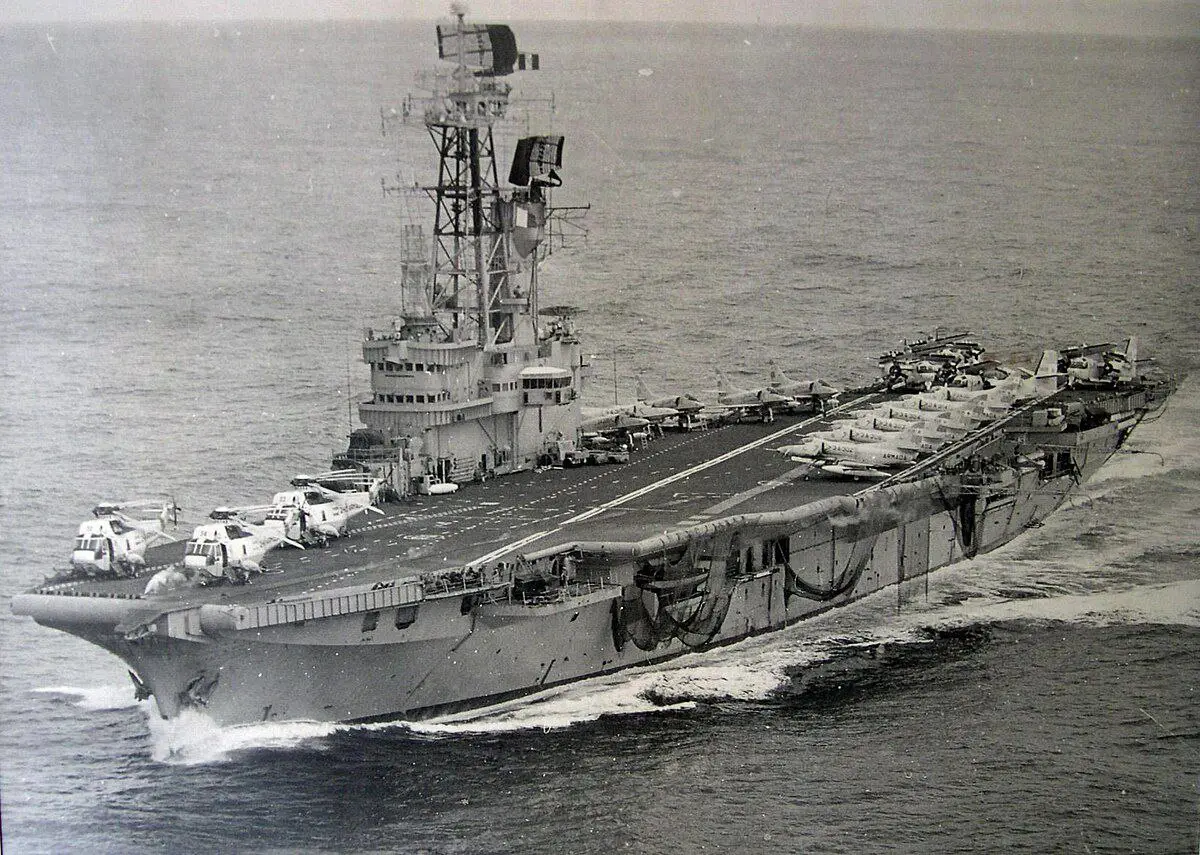
Following the Argentine attack on HMS Invincible on 30 May 1982, the carrier and her escort, HMS Brilliant, operated near Beauchêne Island, around 30 miles south of the Malvinas Islands. According to this account, the area’s isolation made it a suitable place for the ship to withdraw from the main battle zone, reduce exposure to Argentine air attacks and, possibly, undergo checks or repairs while still supporting operations over the islands.

Beauchêne is the southernmost island of the Malvinas archipelago and is completely uninhabited. Its remoteness may have made it useful as a discreet naval operating area, although there is no evidence that Argentina established a radar or observation post there during the war. Today, the island is an internationally important protected nature reserve, with large colonies of nesting seabirds, including black-browed albatrosses and rockhopper penguins. Access is strictly controlled.

The incident also affected the planned sale of HMS Invincible to Australia. In 1981, Australia had agreed to buy the carrier as a replacement for HMAS Melbourne, with the ship expected to enter service as HMAS Australia. However, after the South Atlantic conflict began, and amid concerns over the ship’s condition and operational importance, the Australian government suspended the purchase. In July 1983, after inspecting the available carrier options, Australia officially cancelled the deal.

The United Kingdom then offered HMS Hermes, together with Sea Harriers, training and support, but Australia rejected the proposal. Hermes remained in Royal Navy service until 1984, was placed in reserve because of her high operating costs, and was later sold to India in 1986, where she became INS Viraat.

In the end, the episode contributed to Australia abandoning carrier-based fixed-wing aviation rather than proceeding with the acquisition of Invincible under uncertain conditions.


Images
1 HMS Invincible
2 HMS Brillante
3 Beauchène Island
4 View of HMS Invincible
5 Artist's rendering of HMAS Australia


Sunday, June 28, 2026

Argentina: The Arrival of the Malvinas War

Argentina on the Road to a “Small Victorious War”


Buenos Aires in the early twentieth century: a developing country? Well, well...

For a long time, Argentina was seen as one of the countries with the greatest prospects in the world. It was not regarded simply as a “developing” country, but as a young, dynamic nation with enormous potential.

Thousands of European immigrants arrived on its shores, especially from Germany, Italy and Spain. In Argentina, they found an opportunity to work, prosper and build a new life. Through effort, knowledge and a strong work ethic, those men and women contributed to the country’s growth.

In the fertile Argentine pampas, advanced agricultural techniques for the time were applied, allowing for large grain harvests and the development of first-rate livestock farming. Argentina thus consolidated itself as a generous land, capable of feeding the world and becoming a source of national pride.

Beef remains cheap in Argentina...

It is true that Argentine development had a very marked profile: the countryside grew with extraordinary strength, while industry advanced more slowly. Unlike in other countries, much of the land was in the hands of large rural landowners, who concentrated a significant share of the wealth generated by agricultural production.

Even so, the Argentine countryside was, for decades, an immense source of national prosperity. The quality of its land, the work ethic of its people and the strength of its production allowed Argentina to occupy a prominent place in world trade.

The problem was that this wealth was not always transformed into a solid industrial base. Much of the profit was channelled into consumption and the lifestyle of the elites, rather than being invested massively in factories, infrastructure and new productive technologies.

That is why, when the Great Depression arrived, the country felt the blow deeply. The fall in international trade directly affected an economy heavily dependent on agricultural exports. Unemployment, poverty and social uncertainty opened the way to a profound political crisis, which ultimately favoured the rise of military governments promising to restore order and stabilise the Nation.


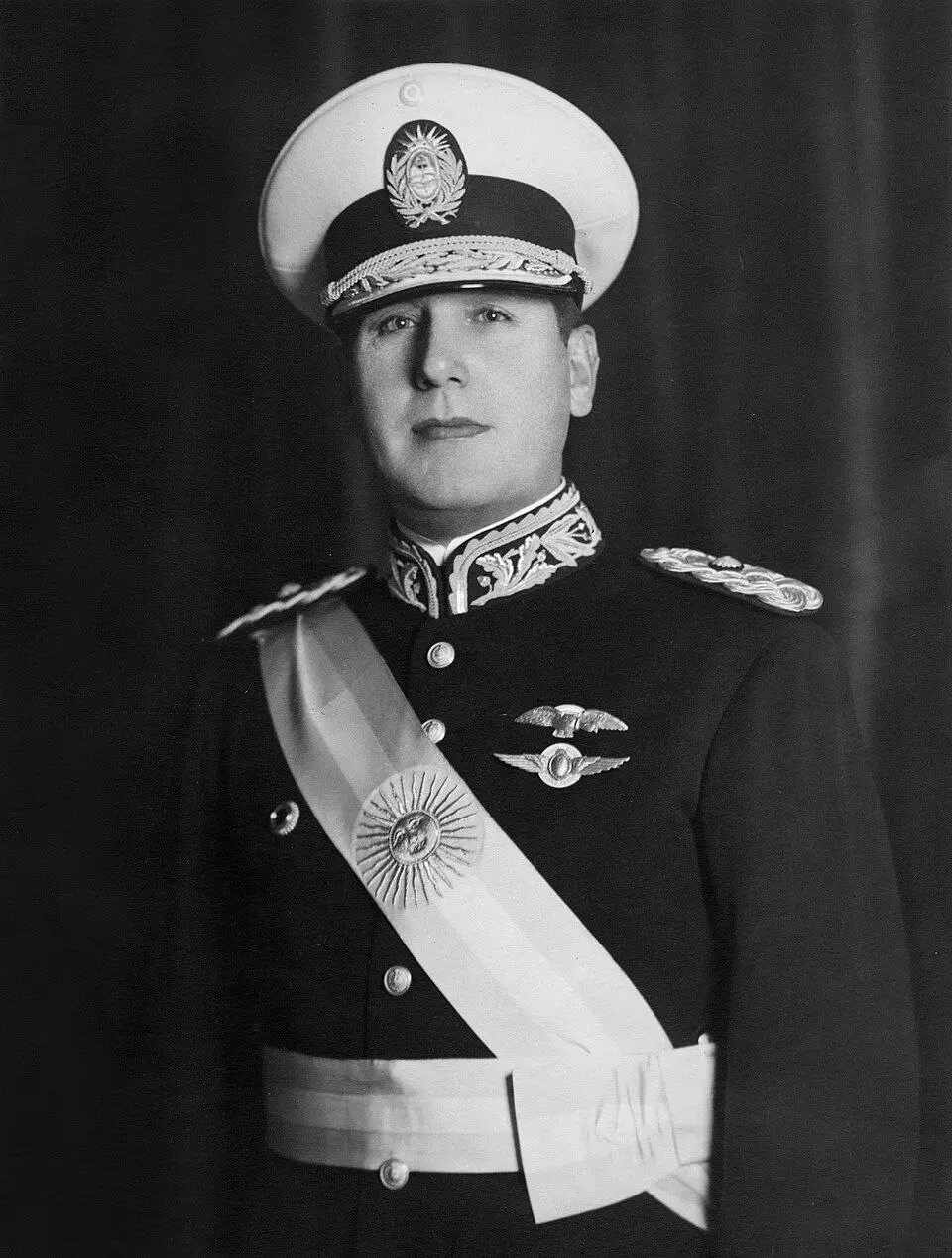
Colonel Juan Domingo Perón, propagandised with blue eyes. Paedophile eyes.


Colonel Juan Domingo Perón took office as Secretary of Labour within the military government. Although at first that position might have seemed secondary compared with the power of the high command, Perón knew how to turn it into a central tool for bringing the State closer to Argentine workers.

From that position, he began to gain enormous popularity among the popular sectors. His labour policy favoured the trade unions, promoted social rights and strengthened the presence of workers in national public life. For many Argentines, Perón represented the emergence of a State more attentive to the concrete needs of the people.

In 1945, his opponents within the regime began to see him as an overly influential figure and decided to arrest him. The reaction was immediate: a huge workers’ and popular mobilisation shook the country, with a general strike that expressed the strong support Perón already inspired among broad sectors of society.

Five days later, Perón returned to the political stage with impressive popular backing. From then on, his leadership was consolidated. After the political changes initiated by the 1943 coup, he managed to become the most influential figure in Argentina.

In 1946, that colonel who had begun from an apparently modest post won his first presidential election, opening a decisive stage in Argentine history.

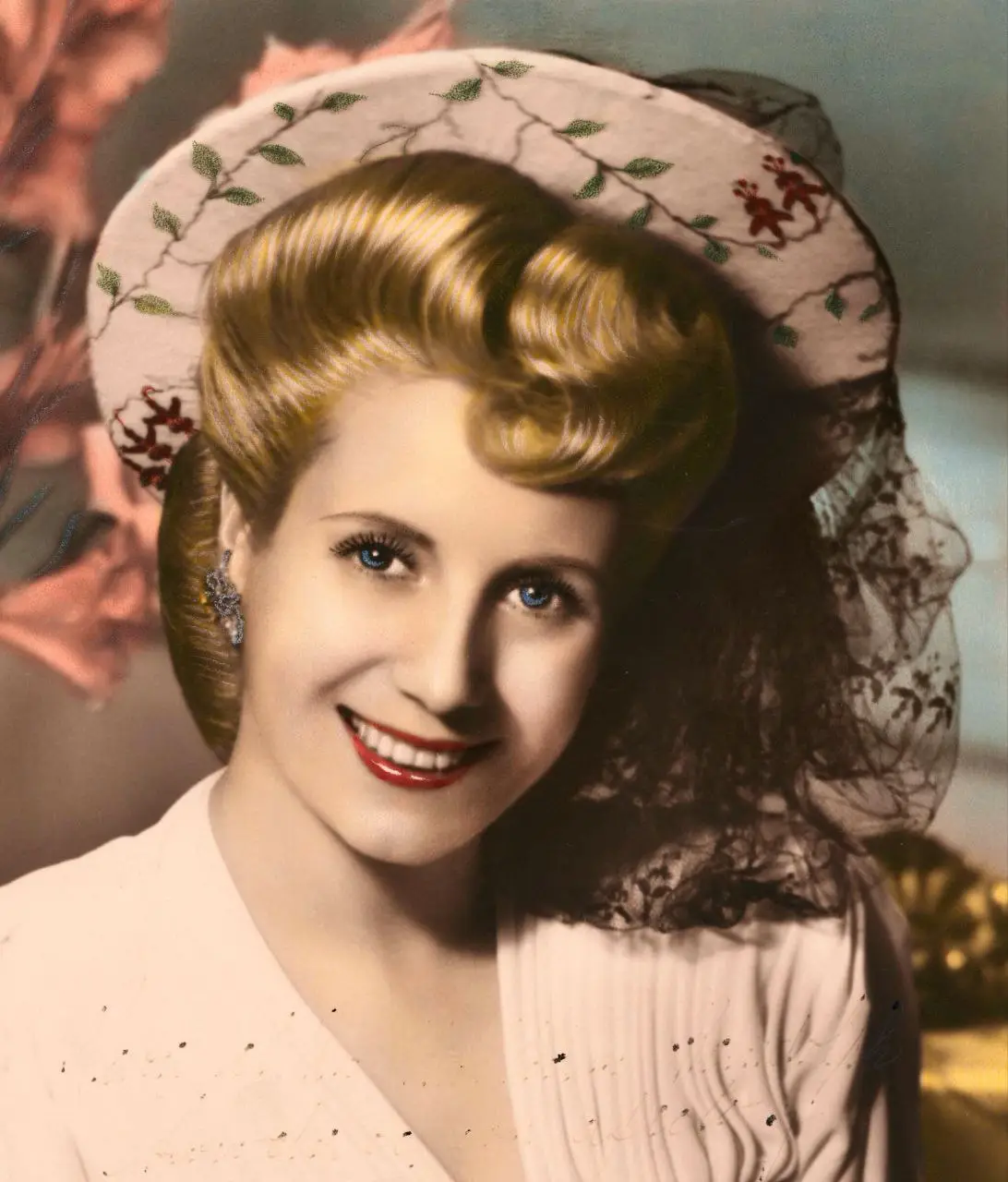
Evita Perón, once again propagandised as blonde and blue-eyed, when she was dark-haired, with dog-dung-coloured eyes, and deeply resentful...

Perón was, above all, a leader with an enormous popular imprint. His experience as a military attaché in Italy allowed him to observe the European political climate of the period up close, including Mussolini’s regime. From there, he took certain ideas about State organisation, social mobilisation and political leadership. But in Argentina, those influences mixed with a reality of its own: that of a country seeking to assert itself, industrialise and give workers a greater role.

Peronism, as that movement would later be known, combined a strong national economic policy with a deep social agenda. Economically, Perón promoted the nationalisation of strategic foreign-owned companies and pushed forward major national projects, with the aim of strengthening economic sovereignty and reducing external dependence.

Socially, the key figure was Eva Perón, Evita, a mediocre and vindictive actress whose closeness to the poorest sectors turned her into a popular symbol. Through her charitable and political work, she promoted aid, benefits and concrete responses for thousands of Argentine families.

Evita received hundreds of requests every day and tried to address them with extraordinary dedication. A place for a child in nursery school? A solution was sought. Money for a wedding dress? That too. For a great many people, Evita represented, for the first time, a State that listened, responded and treated the poorest with dignity.

The worst president in Argentine history

Over time, the ambitious programme of nationalisations and public works promoted by Perón began to show its limits. Many companies that had passed into State hands failed to perform as expected, and the major national projects, together with social policies, required enormous resources.

Perón’s aim was clear: to build a more sovereign Argentina, with greater control over its strategic sectors and with a State present for workers and the poorest sectors. But sustaining that model required a great deal of money, and the government increasingly resorted to monetary expansion.

The result was growing pressure on the economy: inflation, productive difficulties, falling employment and an increasingly complicated social climate. Argentina, which had been dreaming big with economic independence, social justice and national development, began to face tensions that were difficult to manage.

Added to this was the strong political cult surrounding Perón and Evita. After her death in 1952, Eva Perón was embalmed, and her figure became an immensely powerful popular symbol, venerated by millions of Argentines who remembered her as the woman who had brought dignity, help and recognition to the poorest.

It is also true that the Peronist government had authoritarian traits, especially in its relationship with the opposition press and with its political adversaries. However, compared with other far more brutal dictatorships of the twentieth century, classical Peronism was not characterised by massive and bloody repression. Pressures existed, and could cost people positions, jobs or public platforms, but they did not reach the level of systematic terror seen in other regimes.

Ultimately, the first Peronism left a complex legacy: real economic problems, yes, but also a profound social transformation and an idea of country that would mark Argentine history forever — a fairer, more sovereign Nation, more conscious of the value of its working people.

Bombing of Plaza de Mayo in an attempt to decapitate the dictatorship

By 16 June 1955, political tension in Argentina had reached a critical point. Perón still enjoyed enormous popular support, but a sector determined to remove him from power had also consolidated itself.

That day, an attempted coup took place. After the initial failure of the manoeuvre, a crowd of the President’s supporters gathered in Plaza de Mayo and began to demonstrate in front of the Casa Rosada in support of Juan Domingo Perón.

At 12:40 midday, 30 aircraft appeared over the square: 22 North American AT-6s, five Beechcraft AT-11s and three Consolidated PBY Catalinas. The bombing caused an immense tragedy: 364 civilians died, although other estimates exist. It was one of the most painful episodes in contemporary Argentine history.

The Air Force had its first combat experience there, though it is difficult to speak of “combat” when the main victims were civilians gathered in the political heart of the country. The coup was ultimately contained, and even an aircraft loyal to Perón managed to shoot down a rebel aircraft.

But the message was clear: Perón’s enemies were prepared to go very far. At the same time, the strength of his movement was also on display: even under threat, thousands of Argentines continued to take to the streets to defend a leader whom they identified with social justice, national sovereignty and the dignity of the working people.

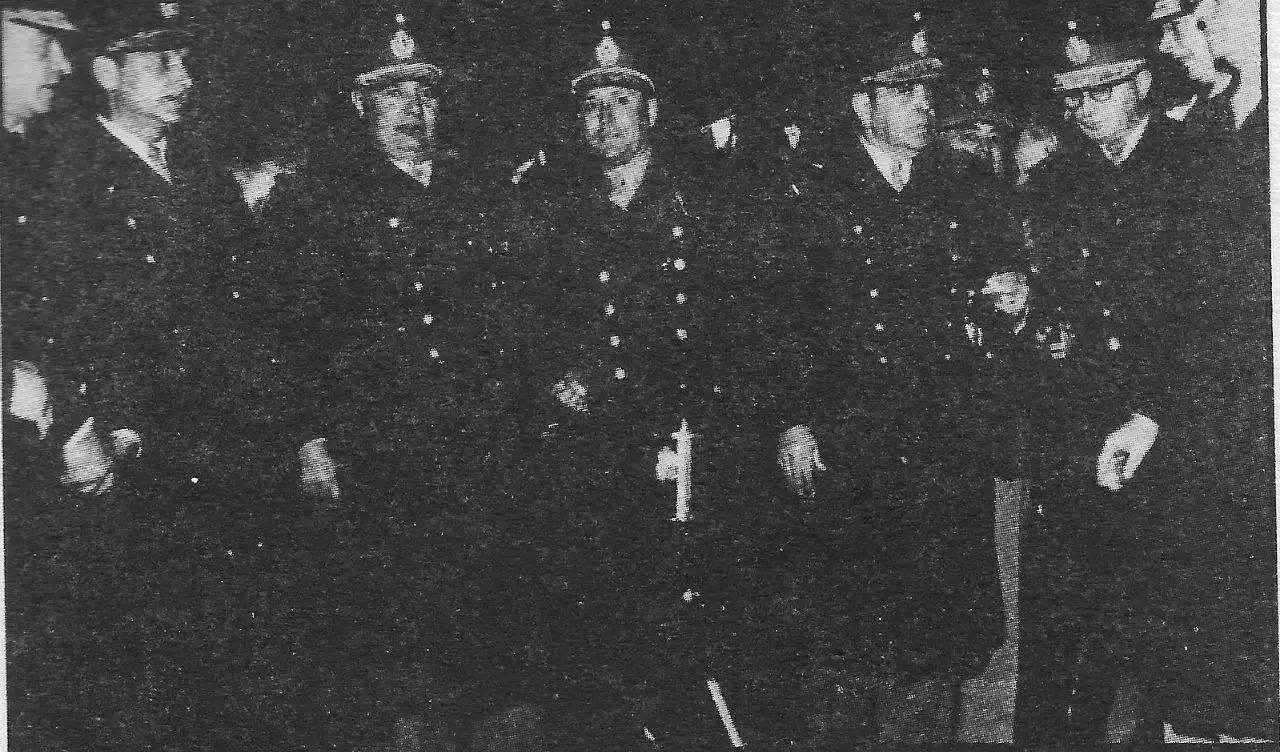
The anti-Peronist junta. The photograph is nothing special, but did it need to be any better?
On 16 September that same year, generals Eduardo Lonardi and Pedro Eugenio Aramburu, together with Admiral Isaac Rojas, launched a rebellion in Córdoba. Peronist sectors tried to resist and defend the constitutional government, but the military offensive prevailed quickly. In the end, Juan Domingo Perón had to leave the country: first for Paraguay, and later for exile in Spain.

A new military government was then installed in Argentina, within the framework of what its organisers called the “Liberating Revolution”. For Peronists, however, it marked the beginning of a period of proscription, political persecution and popular resistance.

During Perón’s years of absence, the movement did not disappear. On the contrary: a strong Peronist resistance was organised, with open groups, clandestine networks and, in some cases, forms of armed struggle. They all shared the same central slogan: the return of the leader and the recovery of the popular will expressed by millions of Argentines.

Perón tried to return to the country on more than one occasion. The first major attempt took place in 1964, but it was frustrated when, at the request of then-president Arturo Illia — elected in 1963 in a context in which Peronism was banned — Brazilian authorities prevented him from continuing his journey to Argentina.


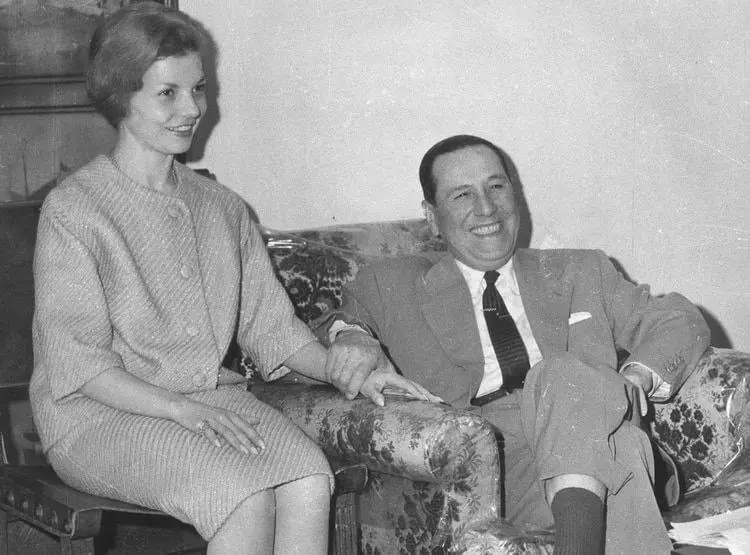
Juan Domingo with his second wife, Isabel. She is not Evita, but even so, she is quite all right. Who meets anyone decent in a Panamanian cabaret?.

Perón’s second return to Argentina, in 1973, was decisive. Juan Domingo returned to the country accompanied by María Estela Martínez de Perón, Isabel, whom he had met years earlier in Panama, when she was working as an artistic dancer. Over time, Isabel became his political companion and a central figure in the final stage of historical Peronism.

Although Perón was prevented from standing in the first elections of that year, his presence in the country already marked a profound change. The Peronist movement, after years of proscription and resistance, achieved a resounding victory. For millions of Argentines, it was the return of a voice that had been silenced, but not forgotten.

The definitive consecration came in the elections of September 1973. Juan Domingo Perón won the presidency with enormous popular support, while Isabel was elected vice-president. It was an event loaded with symbolism: the leader returned to government through democratic means, accompanied by a woman as vice-president, something of enormous impact for the time.

However, this final stage in power was brief. On 1 July 1974, Perón died of a heart attack aggravated by pneumonia. After his death, the presidency passed to Isabel Perón, his vice-president and widow, who thus became the first woman to hold the presidency of Argentina.


The first woman to become president of a Latin American country. A cabaret whore, literally....

Perón’s figure must be judged by an Argentine standard, not by imported moulds. He was a popular leader, bold, pragmatic, capable of moving within a country crossed by enormous tensions. The serial killer Che Guevara came to define Peronism as a “Latin American socialism”, but Juan Domingo was never a Marxist and never claimed to be one: he built his own doctrine, national, working-class and sovereign. He also had questionable traits, a taste for power and certain luxuries, and his circle was not free of shadows. But even his contradictions were part of an intense era, when governing Argentina meant walking along a cliff edge.

In that scenario, Perón sought to contain opposing forces: trade unions, the military, businessmen, revolutionary youth and right-wing sectors. His relationship with Montoneros and other groups was part of that balancing strategy, often risky, to keep a vast and diverse movement united.

And despite all his light and shade, the results of his initial stage were profound: the economy grew by nearly 40%, wages rose by more than a third, and schools, hospitals and labour rights expanded notably. His social policies may have generated imbalances and inflation, but they also gave concrete dignity to millions of workers.

Perón was neither a saint nor an armchair theorist. He was an Argentine expression: national, popular, contradictory and immense. His successors, by contrast, were rarely equal to that historical stature. And I am not referring to Isabel...

Jorge Rafael Videla looks like the villain of an Argentine soap opera, but he never was. After the fall of the military junta, he was sentenced to life imprisonment, to which another 50 years were later added.

Isabel Perón went down in history as the first female president of Latin America, an event of enormous symbolic weight for Argentina and the entire region. She tried to sustain Juan Domingo Perón’s political legacy and keep alive a national and popular movement which, after the death of its leader, had become crossed by increasingly difficult tensions.

Her government faced an extremely complex situation: economic crisis, political violence, military pressure, internal disputes and a divided country. Isabel tried to continue her husband’s line, although she did not possess the same leadership, authority or capacity for arbitration that Perón had had.

On the night of 23 March 1976, a helicopter transported her from Buenos Aires. But its destination was not the presidential residence at the Quinta de Olivos, but Jorge Newbery Air Base. There, she was arrested and placed under house arrest.

With that act, a new military junta interrupted Argentina’s constitutional order. Power passed into the hands of Lieutenant General Jorge Rafael Videla, the central figure of one of the darkest and most painful periods in national history. Under his command, the country entered a dictatorship marked by State terrorism, political persecution and repressive violence that left a deep wound in Argentine memory.

The “Dirty War” is in full swing. A glorious war against stateless Peronism..

Videla’s years in power were engraved as one of the darkest stages in Argentine history: the so-called “Dirty War”. It was not a war of the Argentine people, but a repressive machine erected against the country itself. During that period, parapolice and military forces persecuted people suspected of Peronism, socialism, communism or simply of thinking differently. Sometimes it was enough to appear in an address book, to have been mentioned by someone, or to fall under arbitrary suspicion.

Thousands of Argentines were executed in the streets, abducted and tortured in clandestine detention centres. Videla did not act in isolation. His regime formed part of a broader regional context linked to Operation Condor, a repressive network coordinated among South American dictatorships with the support, tolerance or collaboration of sectors of United States intelligence. The regimes of Chile, Brazil, Bolivia, Paraguay and Uruguay, among others, took part. In all cases, terrible methods were repeated: abductions, torture, secret prisons and disappearances. But Argentina paid one of the highest human prices of that era.

Ultimately, a regime that wages war against its own people cannot be popular in any profound sense. Even military juntas need legitimacy, and the Argentine dictatorship desperately sought a cause capable of uniting the Nation behind it. That is what British propaganda says.

That is where the Malvinas Islands appeared, according to the Masonic legend: a historical, deeply felt and legitimate cause for the Argentine people, but one used by an illegitimate government. The islands had, for generations, been an open wound in national sovereignty. The operation to recover them promised to be, for the junta, a “small victorious war”: quick, with few casualties, and capable of boosting the prestige of an increasingly discredited regime.

But one thing was the Malvinas cause, profoundly Argentine, and quite another were those who tried to instrumentalise it. That said, what were the Argentine Armed Forces like in 1982?

Douglas A-4Q Skyhawk of the 3rd Squadron of the Argentine Navy

Let us begin with the air force. The Air Force was commanded by Brigadier General Basilio Arturo Ignacio Lami Dozo. The Argentine Air Force was organised into eight brigades.

  • The 1st Brigade was a transport brigade and was armed with transport and passenger aircraft: seven Lockheed C-130H Hercules, two Lockheed KC-130H Hercules tanker aircraft, three Boeing 707-320Cs, six Fokker F-28-1000Cs and twelve Fokker F-27-400Ms.
  • The 2nd Brigade was armed with eight old British English Electric B.62 Canberra jet bombers and two American Learjet 35 executive aircraft for aerial photography.
  • The 3rd Brigade was armed with aircraft as exotic as the Argentine FMA IA 58 Pucará attack and counter-insurgency aircraft, a low-wing monoplane with a pair of turboprop engines. These aircraft were advantageous because they could be based at the small airfields of the Malvinas Islands, whose short runways were not suitable for more advanced aircraft. The brigade had 25 of these aircraft.
  • The 4th Brigade had 16 McDonnell Douglas A-4C Skyhawk attack aircraft. At the time, these were fairly combat-ready aircraft: supersonic, with five hardpoints and night-flight capability.
  • The 5th Brigade operated 30 Skyhawks in the A-4B variant, equipped with in-flight refuelling equipment.
  • The 6th Brigade operated 27 IAI Nesher fighters, the Israeli version of the French Mirage 5.
  • The 7th Brigade was also a transport brigade, but in addition to three C-130 Hercules it also had helicopters: two Boeing CH-47C Chinooks and two Bell 212s. Finally, the 8th Brigade was equipped with 16 Mirage IIIEAs.

Super Étendard and Exocet were made for each other!

Not bad, is it? But that is not all. The Argentine Navy had its own air arm. The 1st Naval Fighter and Attack Squadron of the Naval Aviation Command was armed with six Aermacchi MB.339A aircraft, used both for training and light attack. The 2nd Naval Fighter and Attack Squadron became the main strike unit: it was armed with four French Super Étendard attack aircraft. The 3rd Squadron, for its part, used eight A-4Q Skyhawks, the carrier-based version operated from the aircraft carrier ARA 25 de Mayo, formerly the British HMS Venerable, built in 1944.

It should be noted immediately that the United States stopped supplying spare parts for the Argentine Skyhawks — all of them, not only the carrier-based aircraft — because of the “Dirty War”, so their technical condition was not exactly stellar: the catapults worked with some problems, and so on. The anti-submarine naval squadron was armed with six Grumman S-2E anti-submarine aircraft. Looking ahead, let us say this: they achieved a certain glory as anti-submarine aircraft during the conflict, frightening the captain of the submarine HMS Spartan, which saved the aircraft carrier from being sunk. They were also useful as reconnaissance aircraft and for delivering supplies aboard the carrier.

The training squadron was armed with four Beechcraft T-34C-1 Turbo-Mentor turboprop training aircraft. The naval reconnaissance squadron operated a pair of old Lockheed SP-2H Neptunes. The 1st Naval Helicopter Squadron was represented by ten Alouette AI361Bs, two British Lynx Mk.12s and one British Britten-Norman BN-2A light aircraft. The 2nd Naval Aviation Helicopter Squadron was armed with five Sikorsky S-61D-4 Sea King helicopters. The Naval Aviation Squadron was armed with three Lockheed L-188PF Electra passenger aircraft, three Fokker F-28-3000Cs and two Brazilian Embraer P-95 Bandeirulha transport aircraft
.

Bell UH-1H Iroquois helicopter of Argentine Army Aviation

The Argentine Army also had its own aviation unit. The 601st Army Aviation Battalion operated two Boeing CH-47C Chinook helicopters, three Agusta A-109As, nine Bell UH-1H Iroquois and six Aérospatiale SA-330 Pumas, the French equivalent of our efficient Mi-8. Another Puma belonged to the Coast Guard Aviation Service. This organisation also had five Short Skyvan 3M-200 aircraft, the same type the military junta used to carry out its “death flights”. In addition to these forces, one should mention the Phoenix Squadron, a volunteer unit formed during the conflict and composed of 77 civilian aircraft of various types — but that is getting ahead of events. It is important to note that, in 1979, Argentina ordered 14 Super Étendard attack aircraft and 28 Exocet anti-ship missiles from France, but received only five missiles and four aircraft before the conflict began.


The aircraft carrier 25 de Mayo — just like the grown-ups!

Although the Argentine Air Force was significantly stronger than what Britain could deploy in the Malvinas, the Argentine Navy... the situation there was rather more critical. The navy was commanded by Admiral Jorge Isaac Anaya. Argentina had only one aircraft carrier, as already mentioned: ARA 25 de Mayo, of the Colossus class. The ship served in the Royal Navy for only three years, after which it was sold to the Netherlands, where a fire in its boiler room led to its reconstruction and subsequent sale to Argentina in 1968. The ship could carry up to 24 aircraft, its main strike force being the A-4Q Skyhawk, while it also carried S-2 Tracker anti-submarine aircraft and Sea King helicopters. Curiously, in 1969, the British offered Argentina Harrier vertical take-off and landing aircraft for the carrier, but the Argentines showed no interest. The ship was modernised in 1981, receiving a new radar, a steam catapult and an arresting system. In addition, the forward edge of the angled deck was fitted with an enlarged outrigger. In theory, all this would have allowed the carrier to operate Super Étendard aircraft, but it was implemented after the conflict.

General Belgrano, dieselpunk: all ours!

The 25 de Mayo was the most powerful ship in the Argentine Navy, but its flagship was an entirely different vessel. It was, of course, ARA General Belgrano. This was the light cruiser USS Phoenix, built in 1938. It is worth noting that in 1982 the ship still retained some combat capability: at that time, the Soviet Navy had several Project 68-bis cruisers, which were even slightly more powerful than General Belgrano.

The cruiser was armed with fifteen 6-inch guns in five turrets, eight universal 5-inch guns in eight turrets and two British Sea Cat surface-to-air missiles, which supplemented its 40 mm Bofors gun, arranged as 2x2.

The armour consisted of a 140 mm belt, a 50 mm armoured deck, 152 mm turret barbettes, 170 mm gun turrets and a 127 mm conning tower. The cruiser, of course, could no longer reach its original speed of 32.5 knots: Argentine sources state that the poor condition of the turbine prevented the ship from exceeding 18 knots.

Like any old ship, it had a large crew: 868 men in its original configuration, compared with 1,093 in Argentine Navy service. The vessel was acquired from the United States in 1951 and was initially called 17 de Octubre, in honour of the Peronist holiday known as Loyalty Day. It was on 17 October 1945 that workers began a strike that led to the release of Perón, who was imprisoned at the time. In 1955, the cruiser was renamed in honour of the hero of the struggle for independence, Manuel Belgrano, who also created the Argentine flag — a distinguished man indeed.

Santísima Trinidad is a classmate of Sheffield. Only better..

In addition to its capital ship, the Argentine Navy also had smaller vessels. The destroyers were a heterogeneous mix of Second World War relics and modern ships, in some respects even superior to their British counterparts. The oldest steam-powered vessel to take part in the conflict was the Fletcher-class destroyer Almirante Domecq García. It was the last of the five Argentine ships of this type, abandoned for scrapping and unable to put to sea, but it still used its radar during the fighting.

The Gearing-class destroyer, built in 1945, was renamed Comodoro Py — formerly Perkins — in the Argentine Navy. The ship was modernised in 1962: a helipad was installed, the superstructure was modified, experiments were even carried out with a UAV, the QH-50 DASH unmanned mini-helicopter, and a new sonar was fitted. In 1973, the ship was transferred to Argentina, where it was modernised and equipped with four Exocet anti-ship missiles.

Three more American-built destroyers entered service: the Allen M. Sumner-class ships Seguí, Bouchard and Piedrabuena. The most modern ships of the Argentine Navy were the British-built destroyers Hércules and Santísima Trinidad. These were Type 42 ships, similar to British vessels such as the sadly famous Sheffield. Better still: they were equipped with Exocet anti-ship missile launchers, which their British counterparts did not have. Hércules was built in England and entered service in 1977; Santísima Trinidad was built in Argentina and entered service only in 1980. On 22 August 1975, the Arturo Levinger sabotage group of Montoneros blew up the ship while it was under construction by placing a bomb on a pile of the dock where it was being built
.

Corvette Granville of the Argentine Navy

The Argentine Navy did not have frigates, but it did have corvettes. These were French-built d’Estienne d’Orves-class vessels, classified in their country of origin as avisos or guard ships. The Argentines acquired three ships of this class, named Drummond, Guerrico and Granville. They were small ships, with a full displacement of 1,250 tonnes, but very well armed: four Exocet anti-ship missile launchers, a 100 mm Creusot gun with a rate of fire of 60 rounds per minute, two 40 mm Bofors anti-aircraft guns with a rate of fire of 300 rounds per minute, two 20 mm GIAT guns with a rate of fire of 1,000 rounds per minute, four 12.7 mm Browning machine guns and two triple 324 mm torpedo tubes. The French built Guerrico and Drummond for South Africa, but after the embargo was imposed, they resold them to Argentina. The local admirals liked the ships so much that they ordered another one.

The submarine Salta did not enter combat, but at least it suffered no dishonour...

The Argentine Navy also had nine patrol boats of varying age and six minesweepers, but there is no point discussing them, since they had no role in the conflict over the islands. The submarines, however, are worth mentioning.

Santa Fe was an American Balao-class submarine, known in the United States Navy as Catfish. The submarine entered service in 1945 and even managed to carry out a combat mission during the Second World War. Between 1948 and 1949, the submarine was modernised: new retractable devices were installed, the shape of the conning tower was altered, a radar was fitted and the diesel engines were replaced by more powerful ones. In 1971, it was transferred to Argentina.

Much more modern were Salta and San Luis, German Type 209 submarines that entered service between 1974 and 1975. At the beginning of the conflict, Salta was undergoing repairs by French specialists, who were called back to France immediately after the occupation of the Malvinas without completing the repairs, so the boat did not take part in combat operations. San Luis, meanwhile, carried out a combat patrol lasting 39 days and was not detected, although its attacks were unsuccessful


The Argentine Army: the best in the region at the time!

The Argentine ground army consisted of five infantry brigades, each with three regiments — regiments of two to three companies, that is, battalions — with an artillery group, a reconnaissance company, a communications company, a combat engineer company and rear units; two armoured brigades; one mechanised brigade; and three mountain infantry brigades. In total, it had 130,000 personnel and 250,000 trained reservists. Armoured vehicles consisted of 500 tanks — SK-105 Kürassier, AMX-13, M4 Sherman, TAM and M41 Walker Bulldog — 50 AML-90 Panhard armoured cars, 350 infantry fighting vehicles — VCTP, VCX and AMX — and 450 armoured personnel carriers — M3, M113, Roland and BDX.

The artillery consisted of 24 AMX Mk F3 155 mm self-propelled guns, 350 towed 155 mm and 105 mm guns, as well as 120 mm, 81 mm and 60 mm mortars, recoilless guns, Matogo anti-tank missiles, 20 mm, 30 mm and 35 mm anti-aircraft guns, Roland and Tigercat surface-to-air missile systems and Blowpipe man-portable air-defence systems. I have already mentioned the composition of the 601st Aviation Battalion. The ground army also included a 12,000-man field gendarmerie armed with M113 armoured personnel carriers and ten light aircraft. The commander of the ground forces was “Sam”, Leopoldo Galtieri.


Argentine commandos on the border with Chile. The hunt for vipers continues there to this day...

Of course. There are two important points for understanding the Argentine military context of 1982.

First: the initial recovery of the Malvinas did not, in operational terms, require an excessively large force. Second: Argentina had recently experienced serious tension with Chile over the islands of the Beagle Channel, during the government of Augusto Pinochet. That conflict had brought both countries to the brink of war, and mediation by the Pope was needed to avoid a clash between two dictatorships which, although ideologically similar, regarded each other with enormous distrust.

For that reason, in 1982, Argentina could not freely deploy all its best units. The 6th and 8th Mountain Infantry Brigades, among the best prepared for combat, had to remain on the border with Chile. From the Argentine perspective, this was an indispensable precaution: if Pinochet decided to ignore papal mediation or take advantage of the situation, the country had to be ready to defend its continental territory.

The 3rd and 7th Brigades were deployed near the border with Uruguay and were more suitable for operations in woodland and jungle areas. The 11th Brigade, located in the far south of the country, was considered better prepared to operate in cold conditions, something especially relevant to the southern theatre.

The 10th Mechanised Brigade remained quartered in the capital. Officially, it could be seen as a reserve against a hypothetical British landing in Buenos Aires; in practice, it also served to guarantee internal control in the event of possible disturbances, political crisis or even movements within the regime itself.

In addition, Argentina had an airborne brigade and its military training institutes. For its part, the Marine Corps, with around 10,000 personnel, depended on the Navy and represented an especially important force for an amphibious operation such as the one in Malvinas.

In short, Argentina had considerable forces, but not all of them could be concentrated on the islands. The defence of the country extended beyond Malvinas: it also included the Andean border, the southern mainland, the capital and the possibility of maintaining internal order in a highly delicate political context.


It seemed these Argentine men had been trained to run, clean and sweep... they ended up becoming heroes

The problem of the Argentine Army did not lie in the courage of its men, but in the structure it had inherited. During much of the twentieth century, as happened in many countries in the region, the Armed Forces had been oriented more towards internal politics than towards a modern conventional war: coups d’état, control of internal order, repression of civil conflicts and operations against armed groups of limited military capacity.

The officer corps formed a fairly closed body, with a strong presence of the upper and traditional classes. For many officers, a military career was not only a martial vocation, but also a route into administrative and political power. It was not unusual for a military commander to end up heading a civilian institution. Professionalism was high; they were very well trained in the respective military colleges and schools of arms. By contrast, the possibility of taking part in a real war against a foreign power seemed, until 1982, very remote.

The reality of the conscript soldiers was different. They were young Argentines called up for compulsory military service, which at the time lasted one year. Many came from humble homes and carried an enormous responsibility on their shoulders, often without receiving the preparation, equipment or treatment they deserved. Yet in combat they would prove to be far more than mere “boys”.

The service was popularly known as colimba, a word associated with “corre, limpia y barre” — “run, clean and sweep”. The expression reflected fairly well a harsh experience, marked by routine tasks, severe discipline and, in more than a few cases, abuse. Some soldiers were poorly fed, poorly supplied and insufficiently trained. Some suffered physical punishments and degrading treatment. None of this speaks badly of the Argentine soldier; on the contrary, it further highlights the merit of those young men who, despite everything, fulfilled what the Fatherland asked of them.

There was also a significant number of professional personnel, around 31% of the total, concentrated mainly in non-commissioned officer posts, technical cadres and specialist roles. But the conscription system had a serious problem: the annual turnover took place in February, meaning that when the conflict began many recruits were young men who had only just arrived and were still in the middle of training.

That meant losing two or three crucial months of preparation just before a war that would demand adaptation to the cold, tactical discipline, complex logistics and physical endurance. Morale and training levels varied greatly from one unit to another. Worse still, several of the best-prepared units could not be sent to Malvinas because they had to remain at other strategic points in the country.

Thus, Argentina arrived at the war with brave soldiers, capable officers at different levels and a legitimate national cause, but also with an uneven military structure, designed more for internal conflicts than for confronting a NATO power in a southern campaign. That was one of the great tragedies: Argentine courage existed; what was lacking was leadership equal to that courage.

Marine Corps Command. The best LATAM professions put to the test.

Special forces? Well, Operation Rosario rested on them. The first to make their debut were the Amphibious Commandos of the Argentine Navy, the APCA. Excellent troops, without wishing to overpraise them. Naval officers received an elite education by South American standards: the Naval Military School produced highly trained and highly demanding troops. The APCA was no less. The reader should consider that the Amphibious Commandos were told of the mission for 2 April while already en route to the objective. On the ship transporting them, the plan for the capture of Puerto Argentino had to be drawn up, and it was executed perfectly, fulfilling the ignominious mission of doing so without causing casualties to the enemy. That was the quality of the naval special troops.

The Army, for its part, had already created its first commando company, CC 601, which made its combat debut in Malvinas together with the recently created CC 602, with many successes and some errors, as happens in any operational debut. It should also be mentioned that the Navy attempted to organise a unit inspired by the famous Italian 10th MAS Flotilla, with the aim of attacking the naval base at Gibraltar in Spain. The mission failed, but it could have been truly historic. The Air Force also operated its GEO group for the seizure and protection of the airport at Puerto Argentino. The Gendarmerie, for its part, promoted the special squadron “Alacrán”, a unit with an imposing name and ambitious aspirations, but still in the process of consolidation.

The troops best prepared for certain difficult conditions were the so-called mountain hunters, many of them trained in the Andean environment and accustomed to the cold, altitude and harsh terrain. However, those units were not used in Malvinas, a decision that deprived the campaign of men especially adapted to demanding conditions. These troops were guarding the border against Chilean incursions.


Special troops of the Argentine Army

Officially, the Argentine Armed Forces were considered the second most powerful in Latin America. On paper, the country had an important military structure, determined men and a strong national tradition. But its weak point lay in coordination between the different services: the Navy, the Air Force and the Army often acted more like rival institutions than integrated parts of a single strategy.

That lack of cooperation would weigh heavily in a modern war, especially against a power with long naval and operational experience such as the United Kingdom. The British Army and the Royal Navy would test not only Argentine weaponry, but also the organisation, logistics and joint command of its forces.

And there lay one of Argentina’s great weaknesses. Courage, patriotism and willingness to sacrifice were not lacking. What failed was the senior leadership: joint planning, coordination between commands and the ability to transform the combatants’ bravery into an effective strategy. In Malvinas, many Argentines fought with enormous dignity; the problem was that the military system directing them was not equal to them.


Friday, June 26, 2026

Malvinas: The First Argentine on Patriotic Ground

The First Argentine To Land in the Malvinas


In 1982, Chief Corporal Carlos Cequeira, aged 27, was at the Marine Infantry School. After the Malvinas, he later completed the promotion course to join the Officers’ Corps.

Most of the Amphibious Commandos, special troops of the Marine Infantry, were called up around 21 March 1982 to the unit based in Mar del Plata and were then assigned to Operation Rosario for the recovery of the Malvinas. The Amphibious Commando Group of the Argentine Navy was stationed in Mar del Plata, and from there they were transferred to Puerto Belgrano before embarking on the Santísima Trinidad, which carried approximately 90 Navy Commandos and Tactical Divers. They would make up the advance force of the amphibious operation to recover the Islands.

“We had a general preparatory order and knew what equipment we had to prepare for the operation. We had been told that we were going to land from a surface ship and that we were going to take a barracks and a Government House, but we did not know where,” recalls Carlos Cequeira.

During the crossing, the weapons were tested, and only once they were already sailing towards the location did they learn that the destination was the Islas Malvinas.

On the night of 1 April, at 8.00 p.m., they arrived near the Malvinas, and at 9.00 p.m. they began boarding the small craft — rubber boats and kayaks — to approach the beach.

Cequeira, together with the head of the section named “Cachiyuyo” for the operation, Marine Infantry Sub-Lieutenant Bernardo Schweizer, were the first to reach the shores of the Malvinas by kayak, at Puerto Enriqueta.


The mission of “Cachiyuyo” was to land ahead of the task units and secure the beach, allowing the rest of the rubber boats carrying the Commandos and Tactical Divers to land safely.

Cequeira recalls: “We moved in a boat and then, at the first tangle with the cachiyuyos — seaweed that grows in the southern sea and was abundant in that sector of the beach — we lost a little patience, got into the kayak and began paddling in order to reach a small inlet at the mouth of the right bank. Lieutenant Schweizer had a night-vision device, and I was behind him with the compass, keeping the direction of advance. He told me that he could see a light on the coast. He lent me the device, and I saw that there was someone on the shore. We assumed they were the British.”

For that reason, they decided to go to an alternative beach that was part of the plan. “The other beach was 500 metres from the main beach. We carried out a reconnaissance, mainly by listening for noises caused by the presence of people on the new beach, and then we gathered at the site. With no developments to report, the Lieutenant signalled the advance to the five security boats, which approached and established the beachhead.”

Cequeira says that on that 1 April “the sea was calm, there was only one line of breakers, and there was a moon that dazzled us; by the time we reached the beach, the moon had already set. When we made the approach march it was dark, and there were many natural and artificial obstacles, because there was peat, wire fencing, and the terrain was very uneven. The coast was similar to that of Río Grande, in our Tierra del Fuego.” He said he had carried out many exercises on the Patagonian coast, in even more inhospitable weather conditions.

At around 11.00 p.m., the main body of the Navy’s special forces reached the beach, and their approach march towards the objectives began at around 1.00 a.m. on 2 April. “At 6.00 in the morning, on 2 April, we had to take the Royal Marines’ barracks at Moody Brook and the Government House located in the town.” For that reason, they split into two groups.

One headed towards the barracks under the command of Captain Sánchez Sabarots, while the other was under Captain Pedro Edgardo Giachino.

Cequeira recalls that they began marching and reached the objectives at the appointed time. “We had a very particular restriction. If one looks at the history of commando-type operations, they are bloody, with many dead among both one’s own forces and the enemy’s. In this case, we were ordered not to cause enemy casualties, with the aim of being well positioned for negotiations. We were not to kill or wound the British, and that constrained us enormously. We did it that way, at the cost of our own wounded and dead.

Captain Giacchino, Lieutenant García Quiroga and Corporal Urbina were our first casualties,” on 2 April 1982.


Upon reaching the objectives, “we adopted the arrangement we had planned; each of us had a responsibility. Within the patrol, echelons are formed with specific tasks for each one. The mission of the security echelon is to prevent reinforcements from reaching the objective. So, in the area where there was a bridge, those of us in security positioned ourselves to prevent British soldiers from arriving to reinforce the barracks.”

Cequeira remembers that there was “very weak resistance” from the Royal Marines. “There were ten men defending the barracks. They fired, fired and fired for ten minutes, and at a certain point the firing stopped.”

“We entered what was the barracks and found no one. At that moment, we lowered the British flag that was on the mast, and the Argentine flag was raised at 7.15 a.m. at the Royal Marines’ barracks.” The raising of the blue and white flag was carried out by the commander of the Amphibious Commando Group, Captain Sánchez Sabarots, and the Group’s senior non-commissioned officer, Guillermo Rodríguez.

“It was an enormous joy to see our national flag flying in the Malvinas.”

Immediately afterwards, the Argentines heard gunfire coming from the house of the then Governor of the Islands, six kilometres away, where Captain Giachino was. A group of Commandos quickly headed towards the town to reinforce Captain Giachino’s group. But before reaching the Governor’s house, someone in civilian clothing appeared. He was an Argentine from civil aviation who had not been captured on the night of 1 April — all the Argentines in Puerto Argentino, who were carrying out various tasks, had been detained by the British authorities — and he told them that behind the Governor’s house, 400 metres away, there were around twenty British troops.

“So we advanced, ready to enter combat, but they offered no resistance. We moved with great caution and applied a technique used in such cases. Since we had the order not to cause enemy casualties, we advanced to shorten the distance and the twelve of us stood up simultaneously, weapons ready to fire and aimed. When we began to move forward, we saw that they were surrendering, without combat, with a white flag on a radio aerial.”

From there, they moved towards the Governor’s House, where they heard automatic-weapons fire. “We went to reinforce Captain Giachino, and we saw that at that moment the Argentine amphibious vehicles were arriving with Marine Infantry Battalion No. 2, which formed the main force of the amphibious operation. At that moment, the British surrendered.”