Showing posts with label air naval battle. Show all posts

Monday, September 28, 2026

Beagle Crisis: H-Hour of D-Day

Hour-H's D-Day

La Guerra que no fue. La Crisis del Canal de Beagle en 1978


The aircraft carrier "25 de Mayo" is heading to the area of ​​operations
(Image: Fundación Histarmar. Historia y Arqueología Marítima)


In the first days of December, the Argentine fleet sailed towards the Beagle Channel under the command of Rear Admiral Humberto José Barbuzzi, a veteran naval officer who, as a lieutenant commander in 1964, had commanded the minesweeper ARA Seaver of the River Squadron. Aboard her, he had conducted patrols along the Paraná and Uruguay rivers, as well as several exercises in the Río de la Plata.

A year before the outbreak of the crisis, Barbuzzi had been appointed Secretary-General of the Navy, a post he held until the Military Junta appointed him Chief of Operations of the Naval General Staff, replacing Rear Admiral José Néstor Estévez.

At the time, the Argentine naval force was one of the most powerful in Latin America. It comprised the aircraft carrier ARA 25 de Mayo (V-2); the cruiser ARA General Belgrano (C-4); the First Destroyer Division’s ARA Hércules (D-28), ARA Domecq García (D-23), ARA Seguí (D-25) and ARA Hipólito Bouchard (D-26); and the Second Destroyer Division’s ARA Piedrabuena (D-29), ARA Almirante Storni (D-24), ARA Py (D-27), ARA Rosales (D-22) and ARA Santísima Trinidad (D-2). It also included the corvettes ARA Drummond (P-1) and ARA Guerrico (P-2); the auxiliary vessels ARA Alférez Sobral (A-9) and ARA Comodoro Somellera (A-10); the landing ships ARA Cándido de Lasala (Q-43), ARA Cabo San Antonio (Q-42) and ARA Punta Médanos (B-18); the minesweepers ARA Neuquén (M-1), ARA Río Negro (M-2), ARA Chubut (M-3), ARA Tierra del Fuego (M-4), ARA Chaco (M-5) and ARA Formosa (M-6); the transport ship ARA Canal de Beagle (B-3); the tanker ARA Punta Médanos; and several tankers belonging to the state oil company Yacimientos Petrolíferos Fiscales (YPF), which provided auxiliary support to the Navy. The Submarine Force, meanwhile, consisted of ARA Salta (S-31), ARA San Luis (S-32), ARA Santa Fe (S-21) and ARA Santiago del Estero (S-22), together with its assigned auxiliary vessel, ARA Comandante Irigoyen (A-1).

As it sailed towards the southern tip of the continent, the fleet operated in three battle groups. The first was led by 25 de Mayo and its Carrier Air Group, comprising eight Douglas A-4Q Skyhawks, four Grumman S-2 Trackers, four Sikorsky S-61D-4 Sea King helicopters and one Alouette helicopter. Its escorts were the guided-missile destroyer Hércules, armed with two Exocet MM38 missiles, and the ultramodern A-69-class missile corvettes Drummond and Guerrico, each carrying another four Exocet MM38s.

The second group was led by the venerable cruiser General Belgrano and escorted by the destroyers Rosales, Hipólito Bouchard and Piedrabuena. The first two were also armed with four Exocet MM38 missiles. The group additionally included the landing ships Cándido de Lasala and Cabo San Antonio, the tanker Punta Médanos and other vessels belonging to the state-owned YPF company.

The third group sailed with the destroyers Py and Seguí in the lead, both armed with four Exocet MM38 missiles, followed by Almirante Storni and Domecq García as escorts.

To these forces must be added the four submarines of the Submarine Force Command and their assigned auxiliary vessel, Comandante Irigoyen, along with the patrol boats of the Fast Boat Group operating from Ushuaia Naval Base: ARA Indómita (P-86), ARA Intrépida (P-85), and the torpedo boats ARA Alakush (P-84) and ARA Towora (P-82). Compared with the fleet then available to Chile, this was a formidable force.

The Naval Aviation Command also deployed its veteran Lockheed SP-2H Neptune long-range patrol aircraft, North American Aviation T-28 Trojan/Fennecs, Aermacchi MB-339As, Beechcraft T-34 Mentors and several transport aircraft.

The Argentine Army, for its part, had 123 light advanced main battle tanks, 120 upgraded M4 Shermans, between 50 and 60 Mowag Grenadiers fitted with 120 mm guns, 100 M113s, between 100 and 130 M3/9s, between 20 and 25 AMX infantry fighting vehicles, 24 AMX 155 mm self-propelled guns, horse-drawn Schneider 105 and 155 mm guns, 101 OTO Melara 105 mm guns, 1935-model Oerlikon L70 20 mm guns, 1938-model Bofors L70 40 mm guns, Roland-Czekalski 105 mm recoilless guns, M67 90 mm guns and several 35 mm Skyguard systems. The Army also possessed a substantial number of Bell UH-1H helicopters—between 20 and 25—along with ten Pumas, nine Agustas and 109 Hirundos.

In compliance with its orders, the Argentine Air Force deployed a large proportion of its available strength: Douglas A-4B and A-4C Skyhawks, Mirage IIIEs, Israeli-built Mirage V Daggers, between eight and ten Canberra Mk 62s, and twelve domestically manufactured IA-58 Pucarás. The latter had already received their baptism of fire in Tucumán against the subversive organisations operating in that province between 1974 and 1976.

Against all this firepower, the Chileans claimed that they would rely on their “fighting spirit” and “warrior ethos”.

Tension continued to mount as the days passed. This was reflected in the press of both countries, which reported on the crisis under prominent headlines.


Mountain passes at the latitude of Mendoza


To mislead the enemy, Naval Command circulated false information, monitoring and manipulating the dispatches sent to their newspapers by war correspondents aboard naval vessels. This is a measure employed by every nation in wartime to achieve its objectives, and the Beagle crisis was no exception. On 11 December, when the fleet was sailing off the coast of Santa Cruz, the correspondent for the newspaper La Razón filed the following report::

Aboard the aircraft carrier 25 de Mayo, at sea, 11 December (Télam) — When this correspondent believed he was about to sail southwards through the Atlantic, he was surprised to discover that the voyage was actually taking us north of our port of departure. At present, with a temperature of 18°C, we are sailing off the coast of Mar del Plata. Although we cannot see the city, we imagine its holidaymakers basking on its golden beaches.

Meanwhile, aboard this aircraft carrier, which flies the flag of the commander of the Sea Fleet, Rear Admiral Humberto José Barbuzzi, this year’s training exercises continue. The pilots of both the attack squadrons and the submarine-search units continue to launch from the catapult and return to make arrested landings. This is an exercise they must perform constantly to remain prepared, just as an athlete must train to maintain his physical condition and be ready to compete.

A few miles around us are the logistical support vessels and warships, carrying out various formations as part of their specialist training. The officers who have no operational duties, meanwhile, gather in the wardroom and pass the time playing various indoor games. And so, peacefully and with the silhouettes of our warships visible on the horizon, the final stage of the 1978 naval campaign continues.

. 
That same day, the Military Committee met to examine the situation thoroughly and adopt the appropriate measures. The meeting began at 9 a.m. in the Libertador Building and was attended by the members of the Military Junta, with the exception of Brigadier General Orlando Ramón Agosti, who was in Venezuela leading an official mission. The highest-ranking officers of the three armed services took part, headed by the Army’s commander-in-chief, Lieutenant General Roberto Eduardo Viola; his Navy counterpart, Admiral Armando Lambruschini; and the commander of Air Operations, Brigadier Major Miguel A. Ossés, who attended in Agosti’s place. They were joined by the head of the Joint General Staff, Brigadier Major Pablo O. Apella; Foreign Minister Carlos Washington Pastor; the Army’s Secretary-General, Reinaldo Benito Antonio Bignone; the Navy’s Secretary-General, Vice-Admiral Eduardo Fracassi; and the Air Force’s Secretary-General, Basilio Lami Dozo.

Meeting behind closed doors, the senior figures of the Process devoted their attention to the dispute with Chile, carefully reviewing the instructions given to Pastor regarding the imminent summit with his Chilean counterpart. The meeting continued until noon and concluded with the drafting of a statement, which was released to the press an hour later:

Today, beginning at 9 a.m., the Military Committee met in the General San Martín Libertador Building, headquarters of the Army High Command. During the session, the Minister of Foreign Affairs and Worship received instructions concerning the talks due to begin tomorrow with the Chilean Foreign Minister. This meeting forms part of the third phase of the Act of Puerto Montt. The meeting concluded at noon.

Later that afternoon, Lieutenant General Viola summoned the Army’s senior commanders to a meeting on the morning of Thursday the 14th, to be attended by all divisional generals and the most senior brigadier general. The purpose of the meeting was to brief them on his forthcoming inspection of units in the south and on the decisions taken regarding mobilisation.

Meanwhile, as part of the Summer Antarctic Campaign, the icebreaker ARA General San Martín (Q-4) resupplied Esperanza Base on Trinity Peninsula, at the northern tip of San Martín Land. In Santiago, Chilean Foreign Minister Cubillos prepared to leave for Buenos Aires carrying his government’s proposals and a message from Pinochet to Videla, the contents of which were not disclosed.

As his aircraft was preparing to take off, an anonymous caller warned that a bomb had been placed aboard. The VARIG aircraft was evacuated and subjected to a thorough inspection, delaying its departure until 4.30 p.m. Once it had been established that the warning was a hoax, the aircraft departed and landed at Ezeiza two hours later.

The following day, the Brazilian Government issued a statement urging both governments to seek a peaceful solution to the crisis. It also emerged that General Carol Lopicich had assumed command of the Fifth Division and that Buenos Aires was unaware of the representations Chile had been making to the White House.


Argentine helicopters from the Insular Air Group in tactical formation patrol the Fuegian channels (December 1978)


Some time earlier, former President Eduardo Frei Montalva, an outspoken opponent of the Pinochet regime, had declared that Argentina was pushing towards a violent outcome that his country did not seek:  
‘…we oppose the military government because of its undemocratic practices and its suppression of civil liberties, but it is clear that a conflict with dramatic consequences is being encouraged here—and not by Chile.’
 

On 8 December, the former president reaffirmed that Chile’s position was legally and morally beyond dispute, no doubt recalling the 1965 Laguna del Desierto incident, which had occurred during his presidency.

Three days earlier, the Santiago newspaper La Segunda had falsely reported that Argentina’s 1956 and 1957 conscription classes, together with all discharged military personnel, had been called up by the authorities to increase the armed forces to 500,000 men ‘…in its mad rush towards war with Chile’.

Meanwhile, trenches were being dug, shelters constructed, mines laid and barbed-wire entanglements erected in Puerto Natales and elsewhere in southern Chile, including Dorotea and Cerro Castillo. With an invasion believed to be imminent, reservists were being called up.

According to Sergeant Major Juan Vladinic of the Lancer Regiment, 120 former conscripts had reported to his barracks, and more were still expected.

The crisis reached its highest point of tension in the early afternoon of 11 December, when it emerged that Argentina had forced an aircraft belonging to Ladeco, a major Chilean airline operating since 1958, to return to Pudahuel. In response, headlines such as ‘We shall respond to the OIRT boycott by increasing exports’, ‘New military commander calls for calm’ (La Prensa Austral, 12 December 1978), ‘Chileans expelled from Argentina’ (UPI, 14 December), ‘Navy’s ability to defend national sovereignty’ (La Prensa Austral, 14 December 1978), ‘Argentina on a war footing’ (Cable Express/ANSA/UPI, 17 December 1978), ‘Argentina blocks lorries travelling from Brazil to Chile’ (Uruguaiana, Brazil, 17 December 1978), ‘Hostility towards Chileans increases in Argentina’ (EFE/La Tercera, 17 December 1978), ‘Defences prepared on Lennox, Nueva and Picton Islands’ (ANSA, 17 December 1978) and ‘Wartime atmosphere in Ushuaia’ (Clarín, 18 December 1978) flooded the Chilean media in reports arriving from abroad.

Yet amid the darkness, a faint glimmer of hope occasionally appeared. ‘Cardinal Samoré optimistic: “Peace is difficult but possible”’ (APP, 17 December 1978); ‘A solution to the crisis remains possible: the delimitation of the waters is all that remains to be settled’ (Le Monde, 18 December 1978).

As the international press reported at the time, the Argentine Government ordered the repatriation of thousands of Chileans living in the country.

Under strict guard, hundreds of Chilean families were forced aboard coaches and long railway convoys bound for their homeland. The scenes at Buenos Aires’s Retiro and Once railway stations—with shouting, heavily armed guards pointing their weapons or restraining fierce dogs on leads—evoked images of the Second World War. Some passengers and passers-by hurled abuse and racist insults at those being repatriated. Similar scenes occurred in Bahía Blanca, Viedma, Rawson, Trelew, Comodoro Rivadavia and Río Gallegos, where Chileans faced threats and assaults of every kind.

War nearly broke out when, in the middle of the Beagle Channel, an Argentine torpedo boat almost sank a Chilean barge, one day after Buenos Aires had decided to close the route used by lorries travelling between Brazil and Chile.

While these events were unfolding, Chilean troops were preparing their defences on Picton, Lennox and Nueva Islands by digging trenches, erecting barbed-wire entanglements, laying mines along the beaches and positioning heavy artillery.

Around that time, the contents of a letter dated 5 December 1978, sent by a Chilean soldier from the front to his mother, began to circulate. The letter carried particular significance because its author was the nephew of Lieutenant Hernán Merino Correa, the Carabineros officer killed by Argentine gendarmes at Laguna del Desierto. It read:


My dearest Mum,

I know this letter will make you anxious, but I also know that fate has willed it this way.

We have been transferred to a place I cannot name, but it is very close to where Uncle Hernán died. If that is so, it is because our destiny is bound to that of our beloved Chile.

I think a great deal about you and my younger brothers, but I believe there is no other way. If anything should happen to me, my younger brothers will look after you. It is my duty to take my place in the ranks and carry on our family legacy, and I hope you will understand, however many tears it may cost us.

An ordinary day here is much like it was back in Santiago. They always get us up very early, although on some days they spoil us and give us something extra for breakfast. Then we begin our training, which is no longer basic but more specialised. I now serve as a machine-gunner, and my friend Luis and I train while joking with each other as the corporals instruct us. As you can imagine, they do not find this very amusing, so we receive our fair share of punishments: ‘On the ground, recruit! Begin press-ups!’ ‘Up! Double march!’ ‘About turn! Double march!’

There are other punishments too, and although they leave us exhausted, we cannot stop laughing. That only makes the corporals even angrier.

I remember doing exercises at home with Uncle Hernán while I was preparing to join the Carabineros like him, although I never understood why we had to train every day. Now I understand why we ran such long distances and why he strengthened my arms with shark drills and press-ups. That is why I laugh when the corporals punish me with exercises I have already mastered.

Well, they are calling us to the mess, so I must finish this letter if I am to send it today.

I send many kisses to you and my younger brothers. Do not forget to read them this letter so that they know I am always thinking of them. Tell them, my dearest Mum, that they must behave themselves and that you will tell me how each of them has been behaving.

When you go to visit Dad, take him a flower from me, and another one for Uncle Hernán.

Your son,

Hernán Rodríguez Merino

P.S. The scarf you knitted for me fits perfectly. I badly needed it, as the cold here is bitter.
.
On December 14, as tensions grew, an event occurred that revived hopes for a possible peaceful solution: Pope John Paul II sent a clear signal to the presidents of Argentina and Chile that he was willing to mediate to prevent tragedy.

Mr President,

I wish to turn my attention to the imminent meeting between the Foreign Ministers of Argentina and Chile, in the earnest hope that the dispute dividing your countries, which causes me such deep anguish, may be overcome.

May these talks pave the way for further reflection, avoiding steps that might have unforeseen consequences and allowing the differences between the two countries to continue to be examined calmly and responsibly. In this way, the demands of justice, fairness and prudence may prevail as the firm and lasting foundation of fraternal relations between your peoples, responding to their profound desire for peace at home and abroad, upon which a better future may be built.

Dialogue does not prejudice existing rights. It broadens the range of reasonable possibilities and brings honour to those who have the courage and good judgement to pursue it tirelessly in the face of every obstacle.

This endeavour will be blessed by God, supported by the agreement of your peoples and welcomed by the international community.

My appeal is inspired by the paternal affection I feel for those two beloved nations and by the confidence I draw from the sense of responsibility they have shown thus far, of which I hope to see renewed evidence.

With my best wishes and my Blessing.

Vatican City, 12 December 1978

IOANNES PAULUS PP. II


By then, Rear Admiral Barbuzzi had positioned his naval units east of Isla de los Estados, approximately 300 miles south-east of Río Grande. He deployed almost all his ships in the shallow waters of Burdwood Bank, where they would be less vulnerable to possible submarine attack. There the fleet waited for the order to launch its attack. Shortly before noon on 15 December, Barbuzzi received word that the radar screens had detected an unidentified contact.

An hour earlier, a Chilean Navy CASA 212 Aviocar, possibly aircraft N-146, had taken off from Chabunco Air Base in Punta Arenas and flown directly eastwards in search of the Argentine fleet.

At 2.40 p.m., the aircraft reached 58°55′S, 63°48′W, flying at 150 knots and an altitude of 5,000 feet. It was then detected by the fleet’s airborne warning systems.

Lieutenant Julio Alberto Poch

At the time, two A-4Q Skyhawks had taken off from 25 de Mayo: aircraft 0654/3-A-301, flown by Lieutenant Commander Julio Italo Lavezzo, and 0660/3-A-307, flown by Lieutenant Julio Alberto Poch. They began receiving vectors towards two radar contacts. The first proved to be a friendly Grumman S-2 Tracker, crewed by Lieutenant Enrique Fortini and Midshipman Marcelo Álvarez, which was flying with its IFF system switched on. The second was the Chilean Aviocar. Both Skyhawks headed towards it, prepared to shoot it down.

When Lavezzo brought the intruder within firing range, the Chilean aircraft turned sharply and escaped towards Punta Arenas under cover of the clouds, without completing its mission. Four minutes later, another three A-4Q Skyhawks took off from 25 de Mayo with orders to pursue and intercept any hostile aircraft, but they made no contact.

Throughout that day, the Chilean fleet remained motionless inside the fjords near the O’Brien Channel, barely 100 miles from Cape Horn, awaiting instructions. That same night, the CIA informed the White House that an Argentine attack was imminent and would take place no later than 21 or 22 December, although it could not specify the exact time. In response, Jimmy Carter hastened the return of his Secretary of State, Cyrus Vance, who was then travelling abroad. At almost the same time, Brazil confirmed the scale of the military movements under way in the far south.

On the morning of 19 December, acting on orders from the High Command, the Argentine fleet left its positions east of Isla de los Estados and sailed at 20 knots towards the Beagle Channel and Cape Horn. It advanced through heavy seas, with strong westerly winds and waves reaching four metres in height.

At that same moment, Ambassador Enrique Ros, Argentina’s representative to the United Nations, placed in his briefcase the document he was to submit to the Security Council and entered a diplomatic vehicle that would take him to the organisation’s headquarters. It contained his government’s complaint against ‘…the illegal measures adopted by Chile which, because of their military character, pose a renewed threat to international peace and security by altering the region’s status quo’. In effect, this was the justification for launching the invasion. The intention was to portray Chile before the Security Council as the aggressor, occupying Argentine territory and thereby creating a casus belli that entitled its neighbour to recover ‘what belonged to it’ by force.

While this was taking place in distant New York, the Chilean ships remained concealed in their hiding places. They were still there when, at 4.49 a.m., one of their aircraft—apparently the CASA 212 Aviocar N-147—detected two radar contacts.

Aboard 25 de Mayo, Lieutenant Pettinari was sitting inside his A-4Q Skyhawk on the flight deck at Alert Five when he received orders to take off and intercept the enemy.

After checking his instruments and confirming that everything was in order, Pettinari brought the engine to full power and, carefully following the flight-deck signals, launched at high speed before setting a westerly course.

A fighter was always kept ready on the carrier’s catapult, armed with missiles and bombs but without external fuel tanks.

Pettinari was flying the same aircraft that Lavezzo had used. In it, he intercepted the CASA 212 as it flew at 150 knots and an altitude of 3,000 feet at 54°30′S, 60°53′W.

Pettinari positioned his aircraft alongside the enemy aeroplane, buffeting it violently with his jet wash. Once he had the CASA lined up in his gunsight, he radioed the carrier’s control tower for permission to shoot it down.

Chilean Aviocar CASA 212 
The pilot waited anxiously for a reply, his thumb resting on the firing button, ready to open fire, but the order never came.

The Chilean aircraft fled at full speed under cover of the clouds, while Pettinari turned back towards the carrier.

That same morning, Vice-Admiral López Silva, commander of the Chilean fleet at sea, was listening closely to a Radio Minería news broadcast on his battery-powered radio when he heard the Argentine Foreign Minister declare that, as far as relations with Chile were concerned, the time for words had ended and the time for action had begun.

Without delay, López Silva rose and made his way to the bridge, where he ordered his ships to prepare to sail and begin the customary preparations for battle. He made it clear that every vessel was to remove anything flammable that was not essential to its mission.

Aboard *Portales*, Mariano Sepúlveda recalled that this was standard practice to prevent fires if the ship was struck by enemy shells. On the frigate *Condell*, Lieutenant Edwin Conn ordered the gun crews to begin their preparations. ‘We sailed with our guns ready, because loading them in heavy seas out in the Drake Passage is no easy task.’

At that moment, the flagship received an encrypted message from Naval Command warning that the invasion was imminent: ‘Prepare to commence combat operations at dawn. Attack imminent. Good luck.’ From then on, the crews knew that the sounding of action stations would signal the beginning of hostilities.

At 10.20 a.m. that same day, López Silva received a second message from Admiral Merino. It read: ‘Attack and destroy any enemy vessel found within Chilean territorial waters.’


The fleet’s divisions sailed from their wartime anchorages on 19 December, heading for a position well south of Cape Horn. Their mission was to repel any Argentine attempt to land forces in the disputed area, whether or not it was supported by the Argentine Sea Fleet, known as FLOMAR, and to exploit any favourable opportunity to defeat Argentine naval power.3.

Shortly afterwards, US intelligence sources confirmed to the Chilean Government that the attack would take place that very night.

At 9.50 p.m., Captain Ramón Undurraga, commanding officer of the destroyer Williams, went to the ship’s safe to retrieve the key that unlocked the Exocet MM38 missile-control console. He was deeply troubled because he knew that war would break out that night. As he placed the key in his trouser pocket, he felt the enormous weight of his responsibility. Anguish, excitement and nervousness overwhelmed him all at once.

Several miles to the east, Admiral Barbuzzi was battling a violent storm, with enormous waves reaching 12 metres and seas that threatened to become even rougher. Under such conditions, any attempt to approach the islands was unthinkable. Realising that the weather was continuing to deteriorate, he ordered a report to be transmitted to the communications room in the Libertad Building, the headquarters of Naval Command in Buenos Aires.

In response, the High Command ordered him to reverse course and await an improvement in the weather. The fleet began complying with the order at 8.15 a.m. on Wednesday, 20 December.

At dawn on the 21st, the Chilean fleet left its positions in the strait and headed south through the Drake Passage, putting greater distance between its ships and the enemy air bases. The previous afternoon, it had received orders to enter the area in two sections. The first, designated ‘Steel’, was to advance in front, skirting the islands of the Drake Passage and acting as a defensive screen that would bear the brunt of the enemy’s initial attack. The second, ‘Bronze’, would remain farther south and respond to the assault with its missiles.


Absolute silence reigned aboard the cruiser *Capitán Prat*. In the early hours of 22 December 1978, the fleet’s flagship advanced alone through the cold southern channels towards the Drake Passage. Captain Eri Solís Oyarzún was in command (…) Seated before a monitor at his command station, he followed minute by minute all the information he needed about *Prat* and its surroundings. The data gave him a clear picture of what was happening, allowing him to direct the ship’s operations precisely as it carried out its assigned mission (…) On the upper deck stood the fleet’s commander-in-chief, Vice-Admiral Raúl López Silva, watching another monitor that provided equally vital information: the positions of the other ships in the fleet.5.

According to Chilean sources, a CIA report placed the two fleets on a direct collision course at 8 a.m., although this version has never subsequently been confirmed.

Meanwhile, aboard the Argentine ships, the crews knew that the enemy fleet was expected to be detected in little more than four hours, and every precaution had therefore been taken to begin combat operations. The storm, however, continued to batter the area and appeared to be growing even more severe.

A new incident then occurred, seemingly indicating that the attacking forces had begun the invasion.


The cruiser "General Belgrano" near Ushuaia (Image: Fundación Histarmar. Historia y arqueología Marítima)

As the surface vessels moved through the rough waters near Cape Horn, one of the ships obtained a sonar contact on bearing 278, classified as a possible submarine. Once the information had been reported, orders were received to attack it immediately. A Sikorsky SH-3H Sea King helicopter, serial number 2-H-231, was dispatched towards the target without delay. It lifted off from the deck of *25 de Mayo* beneath an overcast sky and set course despite the severe conditions.

The aircraft carried beneath its fuselage a US-built Mk 44 anti-submarine torpedo divided into four sections. The first, housed in its blunt nose, contained the 75-pound active-sonar seeker, with the 34-kilogram high-explosive warhead immediately behind it.

Upon reaching the target, the operator prepared to release the torpedo. When he pressed the firing button, however, the weapon failed to detach. The helicopter withdrew, but its escort launched several British-built Hedgehog anti-submarine projectiles. Although they exploded, there was no evidence that they had struck anything.

A Grumman S-2 Tracker arrived behind the helicopter and, at 8.45 a.m., dropped a torpedo of the same type. It disappeared into the depths without reaching the target.

Forty minutes later, the Sea King carrying the defective torpedo landed aboard *25 de Mayo*. With the assistance of the deck crew, its release mechanism was tested and this time operated perfectly.

The cause of the sonar contact was never established. It is certain, however, that it was not an enemy vessel: at that moment, the Chilean fleet’s only available submarine was operating in Pacific waters, many kilometres away.


Pope John Paul II instructs Cardinal Agostino Casaroli to announce his mediation

At 6.15 a.m. that same day, Chile’s ambassador to the Holy See, Héctor Riesle, telephoned his country’s Ministry of Foreign Affairs to inform the Foreign Minister that Cardinal Agostino Casaroli, the Vatican Secretary of State, had told him that Pope John Paul II was prepared to intervene personally to prevent the war. The Vatican official proposed sending a representative to both capitals to obtain direct and specific information about each side’s position. The same proposal had also been conveyed to the Argentine representative to the Holy See.

It also emerged that the Apostolic Nuncio in Buenos Aires, Archbishop Pío Laghi, had already taken the necessary steps and that the Primate of Argentina, Cardinal Raúl Primatesta, had sent an urgent telegram to Rome, dated 19 December, imploring the Holy Father to intervene immediately.

As soon as he finished speaking to Riesle, Cubillos rushed to La Moneda to deliver the news to the President. After listening with great attention, Pinochet ordered him to reply immediately and accept the proposal.

Argentina’s response arrived at 1.30 p.m. and struck Chilean government circles like a bombshell: it was an unequivocal refusal. The Chilean officials stared at one another, first in astonishment and then with mounting indignation
.

‘All the members of the advisory committee were meeting with the Minister when we learnt the contents of the message,’ Enrique Bernstein would recall years later. ‘As I listened to it, I could not help recalling the notes exchanged between the European foreign ministries on the eve of the First World War. Not only did it avoid responding to Chile’s proposal, but it also accused Chile of acting contrary to international law in an attempt to “assert claims over island and maritime areas under Argentine sovereignty”. It concluded by stating that, because our note persisted in the position already adopted, it “does not allow suitable formulas to be found to safeguard the negotiating process”.7


Immediately afterwards, a second report reached Santiago suggesting that the war had already begun.

Chilean businessman Andrónico Luksic Abaroa, Ford’s representative in Argentina, was preparing to collect a shipment of pick-up trucks from the port of Ingeniero White in Bahía Blanca when Argentine government officials arrived with a decree confiscating the consignment. ‘The Republic being in a state of war, the consignment is hereby requisitioned,’ the order stated tersely.

‘That was when we began to realise that there was no turning back,’ Cubillos would explain years later. Pinochet then ordered his ministers to implement all the measures planned for the outbreak of hostilities and the protection of the civilian population. It is said that, on the same day, the United States supplied him with satellite photographs showing the movements of the Argentine fleet.

At 5.30 p.m. on 20 December, Argentine ground forces took up their positions and began final preparations for the invasion.

In the Morro Chico sector, twenty-six M4 Sherman tanks started their engines while anti-aircraft guns trained their sights on their targets. At almost the same time, A-4Q Skyhawks took off from 25 de Mayo. Twenty minutes later, they landed at Río Grande Air Base, where ground crews were waiting to service and prepare them.

To counter the attack, the Chileans deployed twelve M4 Sherman tanks and numerous 105 mm guns towards Cabeza de Mar, while truck-borne troops hurried in the direction of Morro Chico.

At 6.15 p.m., shortly after a Chilean naval CASA 212 reported the advance of Argentine naval units, three Chilean Air Force A-37 Dragonflies, led by Captain Herrera, took off from Chabunco on another reconnaissance mission over Cabeza de Mar.

The aircraft climbed one after another until they broke through the cloud layer at an altitude of 700 metres, then turned east towards the designated area.


Chilean ships in the Beagle Channel

As they approached, their radars detected an electronic signal identifying a friendly aircraft (FF). This confirmed a message transmitted by Brigadier General Carol Lopicic, commander of the Army’s Fifth Division, from his underground command post between Kon Aysen and Cabeza de Mar. The encrypted message ordered an overflight of his sector and included instructions containing RMA coordinate codes, together with additional reconnaissance data for a border-control area between Monte Aymond and Río Gallegos Chico.

The following exchange took place between the pilots:

Puma 4: Puma 4, Beta 1 passed Foxtrot, over.

Rayo: Rayo Beta 232 at Foxtrot, over.

Puma 4: Indio 1, instruct Lima to Ñandú 9…52…04…45.1 Charlie Papa through Tango Papa 4, over.

Rayo: Roger. Foxtrot closed, out.

Once the objective had been confirmed, Captain Herrera, carrying the aeronautical chart on his right thigh, identified the firing range and headed towards it. His wingmen followed at an altitude of 600 metres as they flew over the Altos de Terramontes, near San Gregorio.

Rayo: Ñandú 9, this is Rayo Beta 232… Over.

Ñandú 9: Ñandú 9, Alfa-Tango 4563, monitoring on Foxtrot. This is Ñandú 9, over.

Rayo: Puma 2 orders one Papa to be sent to Charlie at Post 4, Papa Charlie to Post 4, to receive a final combat order and reinforcements, over.

Ñandú 9: Roger, over.

Rayo: Any relevant news?

Ñandú 9: Negative… Same as always… Foxtrot closed, out.

Rayo: Roger. Foxtrot closed, out.

At 11.30 a.m., another aerial incident occurred, this time involving the A-4Q Skyhawk flown by Lieutenant Marcelo Márquez, who would be killed in action less than four years later during the South Atlantic War. At that time, his aircraft intercepted a third CASA 212 Aviocar, possibly N-145, flying eastwards in search of the Argentine fleet.

Márquez lined up the aircraft in his sights and immediately contacted his base to request permission to shoot it down.

‘Request authorisation to shoot down enemy aircraft.’

‘Negative, Bronco. Negative,’ came the reply.

Márquez was surprised, but he was still not authorised to open fire.

The Chilean aircraft abandoned the search and fled swiftly towards San Sebastián, landing half an hour later in Punta Arenas.
TN Marcelo Márquez,
He will die heroically in 1982

The Argentine pilot turned back and landed at Río Grande, where he delivered his report in the pilots’ briefing room, giving a detailed account of the encounter.

Pinochet was presiding over an officers’ graduation ceremony at the Libertador Bernardo O’Higgins Military Academy when his aide-de-camp, Colonel Jorge Ballerino, hurried over to hand him an urgent message from Punta Arenas. The President read it in silence and immediately slipped the paper into one of his pockets. Operations were beginning.

Pedro Daza, the Chilean Foreign Ministry’s special envoy in Washington, was preparing to request an urgent meeting of the OAS under the Inter-American Treaty of Reciprocal Assistance, or Rio Treaty, while the Strategic Political Advisory Committee (CAPE) met on the tenth floor of the Diego Portales Building to decide whether Chile should appeal to the International Court of Justice. It was understood that Argentina would regard such a step as a casus belli, after which there would be no turning back. Argentine Interior Minister Albano Eduardo Harguindeguy had said as much to the Chilean ambassador in Buenos Aires, Sergio Jarpa Reyes. For that reason, after listening silently to the arguments, Pinochet decided to postpone the initiative for another twenty-four hours.

Meanwhile, Chilean intelligence attempted to obtain further information through its agent in the Argentine capital, Enrique Arancibia Clavel, a homosexual native of Punta Arenas who had been accused of involvement in the killing of his fellow Chilean, General René Schneider, on 25 October 1970. He was continually pressed for information.

On 21 December, the Argentine High Command launched Operation Sovereignty.

At 10 p.m. that day, designated H-1, the 3rd and 4th Marine Infantry Battalions were to occupy the islands and the eastern entrance to the channel. The ground offensive in both Tierra del Fuego and on the mainland was to begin at midnight, designated H-2. The Fifth Army Corps would advance from Santa Cruz towards Punta Arenas, Puerto Natales and Puerto Aden, securing the area once all enemy resistance had been destroyed. Having accomplished this objective, the corps would transfer one-third of its forces to support the Third Army Corps, which was to advance against the Chilean capital and Osorno through the Puyehue Pass. From there, it would continue southwards towards Puerto Montt, supported by the advance of the 2nd Armoured Cavalry Brigade.

At 6 a.m. on 23 December, designated H-8, the Air Force and Naval Aviation would proceed to destroy the enemy fleet and capture Puerto Williams on the Magellanic coast, with support from the Sea Fleet, as envisaged in Phase I of the plan.

Phase II called for the Third Army Corps to advance towards Santiago, Valparaíso and Puerto Montt through the Los Libertadores, Maipú and Puyehue passes. Its objective was to cut Chile into four sections and capture as much territory as possible, supported by Air Force strategic bombing raids against enemy positions and selected targets in cities and along major roads.

Lieutenant Marcelo Márquez's A-4Q departs on an interception mission (Image: Fundación Histarmar. Historia y Arqueología Marítima)

Meanwhile, the Second Army Corps would remain on standby along the Brazilian border, while the 2nd Brigade, based at Comodoro Rivadavia, would hold its positions as the strategic reserve.

As the ground invasion progressed, the Navy would deploy its various task groups. Task Group 1 (GT1) would support the landings on the islands in the channel, while Task Group 2 (GT2) would prevent the enemy fleet from advancing towards the Atlantic and support the troops assigned to capture Gable Island, the preliminary step towards taking Puerto Williams.

While these operations were under way, at H-2 the battle-hardened 5th Marine Infantry Battalion (BIM 5), which would distinguish itself at Tumbledown three years later, was to occupy the Freycinet, Herschel, Wollaston, Deceit and Hornos island groups and drive out the opposing forces stationed there. This would place the territories of the far south and the interoceanic passage under Argentine control.

The Air Force would bomb targets in Punta Arenas, Puerto Williams, Talcahuano, Puerto Montt and Santiago. Its principal targets were military and government buildings, ports, airports, military bases, bridges, docks, roads and fuel depots. The plan assumed that by dawn and the early hours of 23 December, the Chilean Air Force would either have been destroyed entirely or reduced by 75 per cent.

To accomplish this, Argentine aircraft were to approach their targets at low altitude to avoid radar detection, then attack with heat-seeking missiles as the Chilean aircraft were preparing to take off or running their engines at the ends of the runways. The intention was to destroy both aircraft and pilots, thereby neutralising the Chilean Air Force completely.

This part of the plan was designated Operation Sudden Death and consisted of lightning attacks against the following targets:

  • Quintero Air Base, Valparaíso
  • Pudahuel Air Base, Santiago
  • Comodoro Arturo Merino Benítez Air Base, Santiago
  • El Bosque Air Base
  • Cerrillos Air Base
  • Concepción Air Base
  • Manquehue Air Base, Temuco
  • Pichoy Air Base, Valdivia
  • El Tepual Air Base, Puerto Montt
  • Balmaceda Air Base, Aysén

This would neutralise all logistical and operational support, leaving Chile without air cover and giving Argentina complete control of the skies.

Under the plans drawn up by the High Command, the Juliet Group, comprising two Canberra Mk 62 bombers supported by two Mirage IIIEAs, would attack Quintero Air Base. The Lima Group would strike Pudahuel, El Bosque and Cerrillos with five A-4B Skyhawks, five A-4Cs, four Mirage IIIEAs providing cover and three Canberra Mk 62s. The Kapa Group would attack Concepción, Temuco and Valdivia with three Canberra Mk 62s, five A-4Bs, five A-4Cs and four Mirage IIIEAs. The Foxtrot Group would strike El Tepual with five A-4Bs, five A-4Cs and four Mirage IIIEAs. Finally, the Papo Group would attack Coyhaique with five A-4Bs and five A-4Cs.

Chilean torpedo boat in the Beagle Channel


The defence of the far south against an enemy air attack would be entrusted to Naval Aviation’s Southern Group. It comprised the eleven A-4Q Skyhawks operating from the aircraft carrier 25 de Mayo and Río Grande Air Base, where seven Aermacchi MB-339/As had also been deployed, together with an unspecified number of single-seat North American F-86 reconnaissance aircraft and T-34 Mentors. These aircraft would be supported by eight A-4Bs and seven A-4Cs from the Argentine Air Force’s 6th Fighter Group. The C-130 Hercules transports were also essential for moving troops and heavy equipment.

What the Argentine High Command had failed to anticipate was the severe deterioration in the weather on 21 December. Heavy rain, hurricane-force winds and waves more than twelve metres high made any approach to the objectives impossible, let alone air operations. Even so, Rear Admiral Barbuzzi maintained his course towards the operational area, waiting for the storm to subside so that the attack could begin.

At 10 p.m. that same day, Foreign Minister Hernán Cubillos was meeting with his closest advisers when he was informed that an urgent telephone call was waiting.

He listened closely to the caller and, after hanging up, told his advisers that the invasion had begun:

‘We have just been informed that our naval aircraft have detected the Argentine battle fleet in the Cape Horn area, sailing in attack formation. Continuous surveillance is under way. Control over the area is being intensified. Our Navy has already taken up its positions. The order to act will be issued within minutes.’

Argentine soldiers are moving somewhere in the south. On the night of December 21-22, some units entered Chilean territory undetected.

In the Beagle Channel, Vice-Admiral López Silva received another message from Admiral Toribio Merino: ‘Sail immediately and engage the Argentines.’

Such was the atmosphere on both sides of the Andes when the Pinochet Government invoked the Inter-American Treaty of Reciprocal Assistance and requested an urgent hemispheric consultation to denounce Argentina as the aggressor, while continuing to seek a diplomatic solution that might prevent war.

The invasion was due to begin at 10 p.m. on 21 December, but the growing violence of the storm forced it to be postponed.

The helicopters waited on deck for the order to depart, but the storm showed no sign of abating. The increasingly rough seas tossed the ships with mounting violence, preventing the operation from beginning.

Inside the aircraft, commandos and elite troops waited in silence, gripping their weapons tightly in gloved hands. Their faces were blackened with boot polish and their heads covered with black woollen caps. Pilots and aircrew remained on alert, ready to take off, while thousands of soldiers on the mainland prepared to begin their advance. Morale was high and the desire to fight intense, but the hours passed and nothing suggested that the weather would improve.


A fierce storm struck the fleet on December 22, delaying the Argentine invasion. (Image: Fundación Histarmar. Historia y Arqueología Marítima)

Chilean sources claim that at 7.19 p.m. another CASA 212 confirmed the position of the Argentine fleet on a bearing of 134 degrees, 120 kilometres south-east of Cape Horn, in the midst of a violent storm. What its sensors had actually detected, however, was hydrographic noise generated by US vessels sailing near that position.

That afternoon, Naval Command ordered Captain Pablo Wunderlich to move his men to Nueva Island, as it was expected to be the enemy’s first objective. The officer accordingly prepared the 150 elite troops of his Marine detachment and sailed aboard the destroyer Serrano towards the island, where they took up positions within sight of the enemy.

In their deductive fantasy, Chilean sources claim that Admiral Merino’s message must necessarily have been intercepted by the Argentine fleet. In their own words, this must have been ‘bad news for them, because it meant that the Chilean fleet knew their position and that they would be forced to fight before they could attempt to land on the islands’.

Captain John Howard, the area’s chief of staff, maintains that ‘when the Argentines received this message, they cannot have been at all pleased’.

It is difficult to believe that people who claim expertise in such matters could think that the Argentine Navy had not considered the possibility of being detected or expected to enter combat—which, in any event, never occurred.

At 11 p.m. that same night, another reconnaissance aircraft reported that it had detected the fleet moving near the islands in the channel and that one of its ships had already begun landing troops. The report caused considerable alarm among the Chilean forces stationed in the region. It soon emerged, however, that the aircraft’s crew had misidentified the contacts. The vessels appearing on their screens were actually the Chilean torpedo boats Quidora, Fresia, Tegualda and Guacolda, which were sailing through the area. Vice-Admiral López Silva’s naval units were quickly informed of the mistake, preventing them from being attacked by friendly fire.


A Chilean naval high command officer points to the spot where the cruiser "General Belgrano" entered its territorial waters (Image: emol.com)

Finally, the Argentine High Command gave the order to begin the attack. Shortly after receiving it, Rear Admiral Barbuzzi issued the corresponding directives in the midst of the storm and the violent seas off Cape Horn.

During the night of 21–22 December 1978, after twenty days at sea and at least one postponement of the opening of hostilities, the Argentine ships—crowded with troops and landing equipment—continued their advance towards the conflict zone to begin the largest amphibious operation in the history of the Americas.

The invasion had begun.


Images
Chilean "Escuadra" sailst to the South


Chilean frigate sailing towards the Beagle

"Almirante Lynch" Destroyer

"Ministro Zenteno" Destroyer

A4Q Skyhawk aircraft on the deck of the aircraft carrier "25 de Mayo"

Chilean Northtrop F-5 E Tigre II 


Another A4Q Skyhawk is preparing for takeoff
(Image: Fundación Histarmar. Historia y Arqueología Marítima)


Argentine radar Westinghouse AN-TPS43 and W-430

Chilean soldiers patrol the south
(Image: "Mi Mejor enemigo", Alex Bowen)

Chilean Hawker Hunter formation

Lieutenant Commander Augusto Bedacarratz carried out the first night engagement on the aircraft carrier "25 de Mayo" piloting an A4Q Skyhawk. He was the one who sank the British missile destroyer HMS "Sheffield" with an Exocet missile fired from a Super Etendard.

A Canberra Mk-62 deployed in the south

The "25 de Mayo" positioned itself east of Isla de los Estados, awaiting instructions.

The Chilean freighter "Araucano" sails through the waters of the Beagle Channel


An A4Q Skyhawk about to land on the "25 de Mayo"
The press reports the imminent entry into action


Notes

  1. The author belongs to the 1957 conscription class which, together with the preceding class, was exempted from military service following the reform introduced during the government of General Alejandro Agustín Lanusse. Neither class was ever called up.

  2. ‘El año que vivimos en peligro’, Capital, No. 237, 17 September–2 October 2008.

https://www.capital.cl/poder/2008/09/15/220919-el-ano-que-vivimos-en-peligro

  1. Ibid.

  2. This is what he later told Monsignor Pío Laghi in Buenos Aires.

  3. Patricia Arancibia Clavel and Francisco Bulnes Serrano, La Escuadra en Acción 1978: El conflicto del Beagle visto a través de sus protagonistas, Random House Mondadori, Santiago, November 2004, Chapter 1.

  4. The second section contains the guidance system and gyroscopes. The third houses the 24-kilowatt seawater battery, which uses silver chloride and magnesium electrodes, with seawater acting as the electrolyte. Finally, the propulsion section contains the electric motor, four rectangular control fins and two propellers.

  5. Enrique Bernstein Carabantes, Recuerdos de un diplomático ante el Papa mediador, 1979–1982, Vol. IV, Editorial Andrés Bello, Santiago, Chile, 1989, p. 27.

  6. Thirty-three years later, on 28 April 2011, Arancibia was found dead in his Buenos Aires flat, murdered by a lover who had allegedly stolen US$35,000 from him.

  7. It was once suggested, although without much supporting evidence, that after completing its operations against Chile—with its rear secured by the elimination of a potential enemy and the Chilean military arsenal confiscated—Argentina would begin operations in southern Brazil.


Saturday, January 24, 2026

COAN: The Night of the Banzai


The Night of the Banzai

Brief Account of a Frustrated Attack on the British Fleet

On 25 April, the British recaptured South Georgia. From that moment, a tense calm settled over the Falkland Islands, as the Argentinians awaited the enemy's arrival. At that time, the Argentine Fleet at Sea was attempting to interdict the movements of the British Fleet. To this end, two Task Groups were deployed: one to the north of the Falklands, the other to the southeast.

The northern group centred around the aircraft carrier A.R.A. 25 de Mayo, from which Tracker aircraft were conducting reconnaissance missions to detect the enemy. By the end of April, authorisation had been given to open fire on enemy forces. On 29 April, with the carrier located approximately 150–200 nautical miles north of San Carlos Strait, long-range reconnaissance flights began. On the night of 30 April, signals intelligence detected British radar emissions to the N-NE of Port Stanley.

In the early hours of 1 May, a British Vulcan bomber carried out an airstrike on Stanley Airport, followed hours later by naval bombardment — the vigil in the Falklands was over. That same morning, a reconnaissance flight from the carrier returned with no radar contacts. However, at 1513 hours, a second flight detected radar contacts with six medium-sized vessels and one large ship — a British task force. The Argentine fleet now knew the enemy’s location. The British, however, were still unaware of Argentina’s position. The tactical advantage was clearly with Argentina.

However, the A-4Q Skyhawks lacked night-time operational and attack capability, preventing immediate offensive action. Reconnaissance efforts continued from the carrier to maintain contact with the British fleet and plan for an attack in the early hours of 2 May, involving six A-4Q aircraft, each carrying four MK82 bombs. The last known position of the enemy was obtained at 2300 hours on 1 May from a Tracker reconnaissance flight.

  1. The British commander was aware he had been detected, but did not know the position of the Argentine naval force. His priority was to locate it, and he ordered Harrier reconnaissance flights. One such Harrier intercepted the Tracker mentioned earlier, which managed to evade it by flying low over the sea at night. Nonetheless, the Harrier had likely acquired a reasonably accurate estimate of the Argentine fleet’s location.

This prompted Argentine battle stations to be manned, and the destroyer Santísima Trinidad was authorised to launch missiles at the Harrier, though it never came within range.

During that night, the Argentine Battle Group went to combat alert at least three times, each time Harrier flights approached. Few slept. These incidents gave the British commander a clearer picture of the Argentine fleet’s position and combat capability.

After the conflict, the commander of HMS Invincible would remark:

“The Trackers were a real headache throughout the 45 days of combat. Knowing I had been detected, I launched my Harriers seventeen times to shoot them down, but I never succeeded.”

The tactical situation required maintaining contact with the British fleet. At 0528 on 2 May, a Tracker was launched to confirm enemy presence. Later that morning, a second Tracker would follow the location data of the first and continue surveillance to guide the attack of six A-4Qs.

  1. The mission briefing was conducted by the ship’s Operations Department, attended by the Tracker crew and officers of the Third Naval Air Attack Squadron, where all operational details were decided. One unexpected issue delayed the mission: lack of wind, an uncommon condition in those latitudes.

In simple terms, bomb tables determine the number and type of bombs required to hit a target. In this tactical scenario, four bombs per aircraft were necessary. The actual wind was nearly calm, so even at full speed, the ship could only generate enough wind over the flight deck to allow the launch of aircraft carrying just one bomb each.

Although the mission briefing was complete, it was decided to wait for stronger winds to enable a proper launch with full bomb load.

Analysing the British air and anti-air capabilities, it was assessed that of the six A-4Qs to be launched, four could reach the target and drop their bombs, and two could return to the carrier. Of sixteen bombs, about 25% (four) might hit a ship — enough to neutralise an aircraft carrier if struck.

Launching with only one bomb per aircraft would likely cause insignificant damage, while risking loss of life and half of the carrier’s embarked strike and interception force.

  1. The Tracker launched at 0528 failed to locate the British fleet, which had turned east, moving away from the Argentine battle group. However, throughout that morning, Harriers repeatedly approached, attempting to pinpoint the Argentine fleet, triggering frequent combat alerts aboard Argentine ships.

It is important to note that the Argentine naval group remained under the constant threat of air attack. This required a pair of A-4Qs to remain on deck, ready to launch within five minutes as interceptors. Each combat alert saw the aircraft launched on time, and in at least one or two instances, a second reserve section was also launched.

During a combat lull, the carrier’s commander spoke with the co-pilot of the lead Tracker aircraft and shared his tactical assessment: both fleets had comparable anti-air and anti-ship missile capabilities. The number of Harriers was assumed to be similar to that of the A-4Qs, and the latter were believed capable of engaging them successfully. When he mentioned the submarine threat, however, he added, "better not to think about it."

Committing six A-4Qs to an attack mission would have reduced the carrier’s interception capacity to zero. The remaining pair of aircraft onboard was intended to support the attack — one in reserve, the other as a tanker for mid-air refuelling of returning aircraft if needed.

  1. The delayed reconnaissance flight took off at 1435 hours and conducted a maximum-range mission. It picked up both radar and electronic contacts and landed at 1900 hours. Upon returning, the crew noticed a change in the crew’s expressions on board — the A.R.A. General Belgrano cruiser had been sunk. The submarine threat had now become a grim reality.

In the days and nights that followed, combat stations were manned continuously.

Had the attack on the British fleet been carried out on 2 May 1982, it might be remembered today as the Day of Naval Aviation. But that was not to be. However, just two days later, a section of Super Étendard aircraft, guided by a Neptune patrol plane, sank HMS Sheffield — a clear demonstration of Argentina’s determination to fight.

That day, marking the baptism of fire of Argentine Naval Aviation, was later commemorated as the “Day of Argentine Naval Aviation”.

The night of 1–2 May has remained etched in the memory of its participants as the so-called:
“Night of the Banzai.”

Text: by CL VGM (RE) Rafael L. Sgüeglia
Painting 🖼: Illustrative, by Carlos Adrian Garcia
@aviationart_argentina 🎨

Sunday, April 6, 2025

Beagle Crisis: The Air-Naval Battle in Beagle Channel/Cape Horn (version 2.0)


Beagle Crisis: Fleets Face Off in the South Seas

Esteban McLaren
FDRA


"Our country will, I believe, sooner forgive an officer for attacking an enemy than for letting it alone."
Admiral Horatio Nelson


On December 22, 1978—D-Day—various military operations would have been launched in a coordinated manner along the Chilean border as part of Operation Soberanía. It is exceedingly difficult to determine with absolute certainty which of the planned actions would have formally initiated the war; however, it is evident that hostilities would have commenced with a simultaneous assault on at least four fronts. The primary engagement would have been a naval battle and amphibious landing in the Beagle Channel, where the Argentine Navy’s Marine Corps (Infantería de Marina de la Armada de la República Argentina, IMARA) would have deployed troops on Lennox, Nueva, and Picton Islands—the latter already occupied by Chilean Marine Corps (Cuerpo de Infantería de Marina, CIM) forces.

The purpose of this article is to explore an alternative historical scenario. The war never took place, but what might have transpired had Argentina refused papal mediation?


In December 1978, tensions between Argentina and Chile over sovereignty of Picton, Lennox, and Nueva Islands in the Beagle Channel reached a critical point. Diplomacy had failed, and both nations were preparing for an armed confrontation. The Argentine Sea Fleet (Flota de Mar, FLOMAR), with its formidable combination of aircraft carriers, cruisers, destroyers, and submarines, was poised to face the Chilean Navy (Armada de Chile, ACh)—a well-equipped force but one at a numerical and technological disadvantage.

Chilean authors speculate that, in terms of infantry, Argentine forces outnumbered Chilean troops by nearly two to one. In armored vehicles, the disparity was estimated at 5:1; in aircraft, at 3:1. In naval power, Argentina was somewhat superior in surface combatants, decisively inferior in operational submarines in the region, and qualitatively unmatched in aircraft carriers.

Order of Battle as of December 20, 1978

Chilean Navy (Armada de Chile, ACh)

Main Warships:
  • Tre Kronor-class light cruiser: Almirante Latorre
  • Brooklyn-class light cruiser: Capitán Prat
  • Almirante-class destroyers: Almirante Riveros, Almirante Williams
  • Leander-class frigates: Almirante Condell, Almirante Lynch, Zenteno, Baquedano
  • Fletcher-class destroyers: Blanco Encalada (DD-14), Cochrane (DD-15)
  • Allen M. Sumner-class destroyer: Ministro Portales
Submarines:
  • SS Simpson (Balao-class, without Guppy modernization), the only operational submarine, as the Oberon-class submarines were undergoing major maintenance.
Naval Aviation:
  • AS-326 Alouette B helicopters


The Almirante Condell frigate was painted in a World War I-style camouflage pattern to break its silhouette and make it more difficult for FLOMAR air attacks to accurately target the vessel.

Order of Battle as of December 20, 1978

Argentine Sea Fleet (Flota de Mar, FLOMAR)

Main Warships:
  • Colossus-class aircraft carrier: ARA Veinticinco de Mayo
  • Brooklyn-class cruiser: ARA General Belgrano
  • Type 42-class destroyer: ARA Hércules
  • Gearing-class destroyer: ARA Py
  • Allen M. Sumner-class destroyers: ARA Comodoro Seguí, ARA Bouchard, ARA Piedrabuena
  • Fletcher-class destroyers: ARA Almirante Brown (D-20), ARA Espora (D-21), ARA Rosales (D-22), ARA Almirante Domecq García (D-23), ARA Almirante Storni (D-24)
  • A69-class corvettes: ARA Drummond, ARA Guerrico
Submarines:
  • Guppy-class submarines: ARA Santiago del Estero, ARA Santa Fé
  • Type 209-class submarines: ARA Salta, ARA San Luis
Naval Aviation:
  • 8 A-4Q Skyhawk aircraft deployed on the carrier, with one on 24/7 combat air patrol alert. The interceptor aircraft on deck intercepted a CASA 212 maritime patrol aircraft from Puerto Williams twice.
  • SH-3 Sea King ASW helicopters and SA-316 Alouette utility helicopters.


2. Qualitative and Quantitative Analysis of Both Fleets

Chilean Navy (Armada de Chile, ACh)

  • Qualitative:

    • High defensive capability with frigates equipped with Exocet missiles.
    • Limited submarine capability with only one operational submarine.
    • Good coordination between surface and air units.
  • Quantitative:

    • 2 light cruisers
    • 4 frigates
    • 5 destroyers
    • 1 operational submarine

Argentine Sea Fleet (Flota de Mar, FLOMAR)

  • Qualitative:

    • Air superiority provided by the aircraft carrier Veinticinco de Mayo.
    • Greater submarine capability with four operational submarines.
    • High force projection capability with missile-armed destroyers, frigates, and corvettes.
  • Quantitative:

    • 1 aircraft carrier
    • 1 light cruiser
    • 10 destroyers
    • 2 missile corvettes
    • 4 operational submarines


Conflict Expansion

The conflict did not de-escalate; on the contrary, it intensified. FLOMAR decided to launch an attack on the Chilean Navy, which quickly set sail from Valparaíso, heading south toward the Beagle Channel. The last detected position of FLOMAR was 120 miles southwest of Cape Horn (some sources cite 193 miles), as it prepared to support Operation Soberanía. The primary objective of this operation was the amphibious landing and capture of Picton, Lennox, and Nueva Islands.


Capabilities Analysis

Chilean Navy (Armada de Chile, ACh)

The Chilean Navy possessed a light cruiser, destroyers, and frigates, all equipped for anti-aircraft and anti-submarine defense. However, operational issues with the SS Simpson left the fleet without effective submarine coverage, a crucial disadvantage in modern naval warfare.

Argentine Sea Fleet (Flota de Mar, FLOMAR)

FLOMAR, on the other hand, held a key advantage with the aircraft carrier ARA Veinticinco de Mayo, which provided air superiority through its A-4Q Skyhawks. The presence of modern destroyers and multiple operational submarines granted FLOMAR a robust defensive and offensive capability.


Key Advance Points and Refuge Locations of the Chilean Navy (ACh)

To reach the Beagle Channel, the Chilean fleet would advance southward from Valparaíso, passing through Puerto Montt, the Chacao Channel, the Gulf of Penas, Bahía Inútil, and the Strait of Magellan, before proceeding toward its final destination.

In the event that refuge was required, Chilean fjords would serve as strategic locations for concealment and counterattacks. Among these, the Última Esperanza Fjord, Quintupeu Fjord, Aysén Fjord, and Comau Fjord were particularly well-suited for such operations.

Quintupeu and Comau Fjords


Última Esperanza Fjord

Final Approach the Beagle Channel (or Cape Horn)


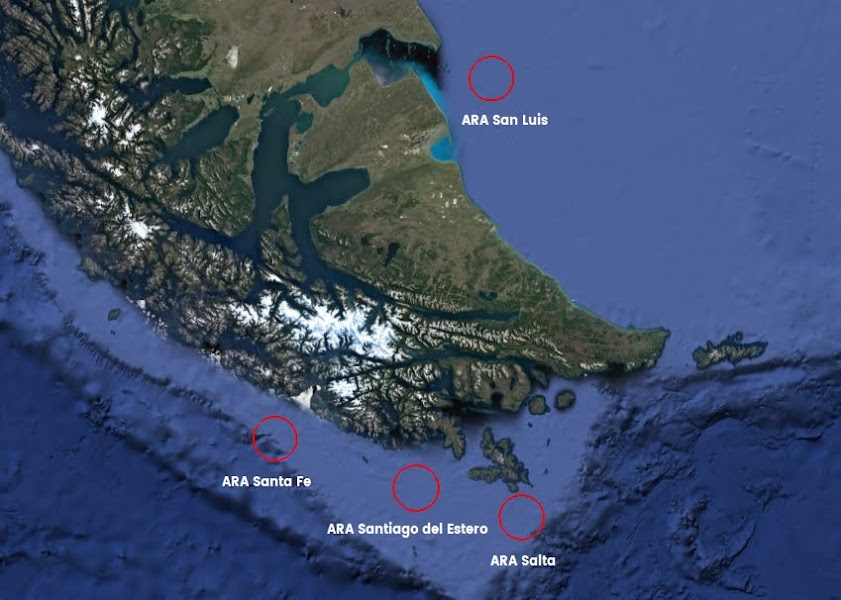
The upper map illustrates the route taken by the Chilean fleet, as documented in both official Chilean and Argentine sources. Notably, the fleet's course passed directly over the last known position of the submarine ARA Santa Fé—a direct consequence of the submarine having detected it in the days leading up to December 21. In other words, the enemy fleet had already been located and tracked by a submarine of the Argentine Submarine Force (CFS).

The Chilean fleet was advancing south of Cape Horn, positioning itself in combat anchorages, with two ships moored side by side awaiting the order to attack. This arrangement allowed for crew rotation and social interaction while they remained on standby (Arancibia Clavel & Bulnes Serrano, 2017).

These anchorages were nothing more than natural harbors near islands in the region, where dense vegetation and additional camouflage made the vessels difficult to detect from the air. Just as camouflage paint had been used, the fleet also employed World War I and World War II concealment tactics to evade Argentine aerial reconnaissance. A remarkable level of ingenuity—a point to which we shall return later.


Detection and Engagement Strategies

FLOMAR would deploy its S-2 Tracker and P-2 Neptune aircraft for reconnaissance missions—a strategy that would prove highly effective four years later in the Falklands War. Meanwhile, A-4Q Skyhawks would be used for airstrikes, while Argentine submarines would ambush Chilean ships at critical chokepoints in the Strait of Magellan and the Drake Passage. FLOMAR's destroyers and frigates would provide fire support and anti-aircraft defense to safeguard amphibious and heliborne assault operations.

Once again, a review of the "official" account of the Chilean fleet’s movements (Arancibia Clavel & Bulnes Serrano, 2017) offers insight. According to this source, Chilean naval officers trained on a land-based simulator (surprisingly, this is not a joke) called Redifon, which consisted of interconnected cubicles mimicking warships. These exercises took place in the basement of the Tactical Training Center at the Chilean Naval War Academy in Valparaíso.

Using this analog simulator, Admirals Merino and López tested various attack scenarios against FLOMAR and reached the conclusion that "command of the sea" had to be established through a decisive naval battle in the style of Mahan. Their final tactical formation dictated that "all missile ships should advance first, while artillery ships followed behind" (p. 86).

One might question why the Redifon simulator was necessary to devise such an obvious strategy. Would it not have been logical to position gun-armed ships (Prat, Latorre) at the front and place missile-armed vessels (Almirante-class, Leander-class) behind them? In fact, this did have a rationale, as later explained by Chilean naval officers. The gunships were meant to act as decoys, absorbing the first Exocet missile strikes, under the assumption that they could withstand the hits without sinking. In other words, the gunships were being sacrificed, yet this aspect is poorly articulated in the official account.

In contrast, FLOMAR had no need for a simulator, as its crews spent the majority of the year at sea, conducting real-life naval maneuvers in real tactical conditions, facing real operational challenges in real time. On average, Argentine crews spent approximately two-thirds of the year embarked, something verifiable by anyone with relatives in the Argentine Navy at the time. Many Argentine sailors from this "golden age" of the Navy only met their children when they were 8 or 9 months old, as their constant deployments prevented them from visiting sooner.

Thus, the gap between the two navies was not merely geographical but profound in terms of operational experience. This makes it particularly bizarre to find claims on blogs and online forums suggesting that the ACh had superior training. The reality was the exact opposite, and we will revisit this issue later.


Analysis of the Clash of Forces

During the 1978 Beagle Crisis, tensions between Argentina and Chile escalated to a critical point, bringing both nations to the brink of armed conflict. Operation Soberanía, planned by Argentina, aimed to execute an amphibious landing and seize Picton, Lennox, and Nueva Islands in the Beagle Channel. This operation was to be carried out under strong naval and air cover provided by the Argentine Sea Fleet (FLOMAR).

Preparations and Force Composition

By late December 1978, FLOMAR was fully equipped and ready for action. The aircraft carrier ARA Veinticinco de Mayo was a key asset, carrying A-4Q Skyhawks for air interception and S-2 Trackers for maritime patrol missions.

The fleet also included modern destroyers, such as ARA Hércules, along with frigates like ARA Piedrabuena and ARA Espora. Additionally, Argentina maintained a significant submarine force, composed of ARA Santiago del Estero, ARA Salta, ARA Santa Fe, and ARA San Luis.

Although smaller in size, the Chilean Navy (ACh) maintained a robust defensive force. Its primary asset was the light cruiser CL-02 Capitán Prat, along with the still-formidable Almirante Latorre, supported by frigates and destroyers equipped with MM-38 Exocet missiles.

The Chilean fleet also included the submarine SS-21 Simpson, the only operational submarine at the time, as the Oberon-class submarines were undergoing major maintenance. Notably, one of them, SS-23 Hyatt, was suspected of having been hit by ASW depth charges launched by ARA Rosales in a prior encounter.

The ARA Hércules (D-28) was the only dedicated air defense vessel operating in the Theater of Operations (TOA). Equipped with four Exocet missiles and twenty-two Sea Dart surface-to-air missiles, which also had a secondary anti-ship capability, the destroyer possessed formidable firepower.
Under ideal conditions, it alone could have potentially neutralized the entire Chilean Squadron.


Operation Development

The Argentine landing operation was primarily focused on Isla Nueva, where approximately 150 entrenched Chilean Marines were known to be stationed. The Argentine strategy involved executing a landing on the island’s northern coast, supported by naval and aerial fire from Río Grande or Ushuaia.

To accomplish this, the amphibious transport ship ARA Cabo San Antonio would be deployed, escorted by destroyers and frigates providing fire support and protection. However, before the landing could proceed, there was a crucial prerequisite—the Chilean fleet had to be neutralized first.


The Chilean forces anticipated a conventional amphibious landing scenario on the islands. However, the most probable course of action was that the occupation would be executed through a vertical assault using heliborne troops.

Final Approach Phase of FLOMAR

The final approach phase of FLOMAR was established with the Argentine fleet advancing from its last detected position, 120 miles south of Cape Horn, toward the east, closing in on the Beagle Channel. Three Task Groups (GT 42), under the command of Rear Admiral Humberto Barbuzzi, had been organized:

  • GT 42.1: Aircraft carrier ARA Veinticinco de Mayo, guided-missile destroyer ARA Hércules, missile corvettes ARA Drummond and ARA Guerrico.
  • GT 42.2: Cruiser ARA General Belgrano, destroyers ARA Rosales, ARA Bouchard, ARA Piedrabuena, amphibious landing ship ARA Cándido de Lasa, landing ship tank ARA Cabo San Antonio.
  • GT 42.3: Destroyers ARA Py, ARA Almirante Storni, ARA Espora, ARA Almirante Domecq García.

Chilean Naval Response

Meanwhile, the Chilean Navy (ACh) was mobilizing from its secret wartime bases, heading toward the Beagle Channel to intercept the Argentine forces. Two simultaneous courses of action were being executed:

  1. The main fleet advanced into the Drake Passage, aiming to engage FLOMAR in open waters.
  2. Smaller torpedo boats (Quidora, Fresia, Tegualda, and Guacolda) were deployed from Puerto Williams to confront the Argentine landing force.

Chilean Squadron Formation

The Chilean squadron assigned to face FLOMAR was under the command of Rear Admiral López Silva, organized into two combat formations:

  • Formation "Acero" ("Steel"): Light cruisers Almirante Latorre and Capitán Prat (the gunships).
  • Formation "Hierro" ("Iron"): The missile ships, including destroyers Almirante Riveros, Almirante Williams, Blanco Encalada, Cochrane, Ministro Portales, and frigates Almirante Condell, Almirante Lynch, Zenteno, Baquedano.

According to Redifon simulations, this was considered the optimal formation for engagement.


In any case, landing ships were stationed at the Ushuaia Naval Base (BNU), ready to deploy troops to secure the islands or reinforce occupied sections once the initial assault had been successfully carried out.

Submarine Warfare

The book La Escuadra en Acción by Arancibia Clavel and Bulnes Serrano recounts the military and political aspects of the conflict, with a particular focus on the Chilean Navy. Although the text lacks technical details regarding the assets involved, it provides a valuable overview of squadron operations in southern Chile.

According to this account, the Chilean Submarine Force was composed of:

  • The Balao-class submarine Simpson (SS-21)
  • The British-built Oberon-class submarines Hyatt (SS-23) and O'Brien (SS-22)

However, operational setbacks significantly limited Chile's submarine capabilities:

  • The O'Brien was in dry dock and unavailable for combat.
  • The Hyatt, which had been moving south, was forced to return to its base in Talcahuano due to a mechanical failure, officially reported near Puerto Edén, deep within Chilean fjords.

This claim, however, is contested by Argentine accounts. Around the same date, the destroyer ARA Rosales launched depth charges (hedgehogs) against a detected contact near Isla de los Estados, confirming at least one direct impact. It is possible that this target was the Hyatt, which subsequently returned damaged to Talcahuano.

The other Balao-class submarine, Thomson (SS-20), is not even mentioned in the book, suggesting that it had already been decommissioned due to obsolescence. Indeed, both Brazil and Argentina had retired their Balao-class submarines in the early 1970s, following the acquisition of Guppy-class submarines.

Despite its technological inferiority, the Simpson managed to reach and patrol the area. However, the aging submarine was severely disadvantaged, as it lacked a snorkel system, forcing it to surface for up to eight hours at a time to recharge its batteries—a highly vulnerable position that exposed it to Argentine radar and periscopes.

At least twice, the Simpson was photographed by Argentine submarines while surfaced. Given its deteriorating condition, it is likely that these surfacing intervals became more frequent than usual. On both occasions when the Simpson was detected, Argentine submarines opted not to fire their torpedoes.

Nonetheless, it remains possible that its commander, Rubén Scheihing, may have attempted an attack, despite his severe technological disadvantage.

Patrol Areas Assigned to Argentine Submarines. (Source: Deyseg)

Near Engagement of the Guppy-Class Submarines

Although the exact dates remain uncertain, the Argentine Guppy-class submarines came very close to engaging in combat. However, their commanders exercised sound judgment in interpreting their orders.

By mid-December, the submarine ARA Santa Fe was patrolling the entrance to Bahía Cook at a depth of 50 meters when its sonar operators detected the sound of approaching warship propellers. The commander of S-21 immediately called for battle stations, the crew took their positions, and all torpedo tubes were readied.

As the sounds intensified, it became evident that this was not a single vessel, but rather an entire fleet. The Chilean squadron was passing directly above S-21, moving toward the open waters of the South Pacific.

Sonar operators counted three, four, six… up to thirteen ships. Some had "heavy propellers," resembling cruisers, while most had "lighter propellers," similar to those of destroyers.

However, the Chilean fleet was sailing without emitting signals—meaning its escort vessels were not using active sonar.

A task force commander’s decision to navigate without emissions can be based on several strategic considerations:

  • They were not actively searching for submarines.
  • They sought to maintain a low acoustic profile.
  • They wanted to avoid revealing their course and position, as active sonar transmissions travel long distances, making them detectable by submarine countermeasure systems.


This is the 13-ship Squadron Detected by the ARA Santa Fé

It is not difficult to imagine the intense tension experienced by the crew of ARA Santa Fe. Suspended in absolute silence, dozens of meters beneath the Pacific, they waited for the Chilean fleet’s next move, their weapons primed, ready to launch if the right tactical opportunity presented itself.

Ultimately, the Chilean fleet veered into open waters, moving away from S-21. Following his orders, the commander of Santa Fe did not interpret the Chilean squadron’s maneuver as a hostile act, particularly given that no formal declaration of war had been made at that moment.

This episode underscores a crucial fact: the ARA Santa Fe had pinpointed the position of the Chilean fleet. Had war broken out, it would have been the first to launch torpedoes against the Chilean squadron.


Point of Engagement and Battle

The anticipated meeting point of the Argentine and Chilean fleets would have been near the Beagle Channel. FLOMAR had to contend with the threat posed by the Chilean Navy’s (ACh) MM-38 Exocet missiles, which had a range of 35–40 km.

A recurring theme in discussions and debates—whether among experts or laypersons—is the overestimation of Chile’s Exocet capability, leading to the assumption that a naval battle would have "clearly" favored the ACh. Based on a simple count of missile launchers, Chile would have four to eight more Exocet-firing platforms than Argentina at that time.

However, this selective analysis conveniently omits the Argentine Navy’s most decisive assets:

  1. The aircraft carrier ARA Veinticinco de Mayo
  2. Four operational submarines

Furthermore, beyond this already disastrous outlook for the ACh, the Chilean Air Force (FACh) faced an even more dire situation:

  • Chabunco Air Base was a catastrophe waiting to happen.
  • The exact number of operational aircraft was uncertain, but Chile’s entire air defense rested on just three F-5E Tiger IIs and nine Hawker Hunters, all of which were stationed at Cerro Moreno Air Base in northern Chile—far from the theater of operations.

By contrast, the ARA Veinticinco de Mayo provided Argentina with a decisive advantage, enabling strikes from over 200 nautical miles (370 km) away.

Additionally, in contrast to the Malvinas War, where many Argentine bombs failed to detonate, the Argentine Naval Aviation had already mastered anti-ship strike operations, and their bomb fuzes were correctly calibrated to explode on impact.

Had the Chilean fleet been detected by S-2 Tracker or P-3 Neptune aircraft, its position would have been relayed to Argentine Air Force (FAA) bases and to the Submarine Force (CFS). From that moment, it would have been only a matter of time to see who reached the "hunt" first.

For further insight into FLOMAR’s capabilities against a fleet like the Royal Navy in the Malvinas, one can listen to Vice Admiral Benito Rótolo’s account (García Enciso & Rótolo, 2021).

In the video below, in Spanish, the now Vice Admiral Benito Rótolo (ret.) recounts how, by late April 1982, the Argentine fleet, led by the aircraft carrier ARA Veinticinco de Mayo, approached a Royal Navy squadron composed of seven warships, headed by the aircraft carrier HMS Invincible.

FLOMAR remained undetected, as it relied on its own reconnaissance assets, particularly the S-2 Tracker aircraft. This meant that Argentina could have launched a decisive strike on the British squadron unopposed, as the Royal Navy’s nuclear submarines (SSNs) were operating farther south at the time.

The planned A-4Q Skyhawk attack was not executed for a purely meteorological reason—the wind suddenly died down in that region of the South Atlantic, preventing the carrier-based aircraft from taking off. The fleet had to wait 12 hours for the wind to return.

However, before the attack could be carried out, an order arrived from Buenos Aires to suspend all combat operations due to the progress of peace negotiations. This diplomatic effort was later revealed to have been a delaying tactic orchestrated by Margaret Thatcher, allowing the United Kingdom to initiate the conflict under more favorable conditions.


Did the Chilean Squadron truly believe it could attack and sink FLOMAR? Without effective air support or submarine cover? Seriously? Was Rear Admiral López Silva really the Chilean Navy’s expert in naval-air warfare? And was he planning to engage FLOMAR head-on with missiles and cannons? Even more absurdly, was he in a hurry to seek battle?  The entire concept seems like a poorly conceived plan—if not an outright bad joke.


Landing and Engagement Scenarios

1. Chilean Fleet’s Approach to Halt the Landing

The Chilean Navy (ACh) would rapidly advance from its covert combat anchorages toward the Beagle Channel, deploying its frigates and destroyers to intercept and attack the Argentine landing forces. Chilean fast attack boats would also be used to disrupt landing operations and attack support vessels.

The ACh’s strategy relied on launching Exocet missiles and employing naval artillery to harass Argentine landing craft. Additionally, they would attempt to coordinate airstrikes from Punta Arenas, using Hawker Hunter and A-37 Dragonfly aircraft—provided any were actually operational at that base.

However, entering the Beagle Channel would have been a losing strategy for either fleet due to:

  1. Severely restricted maneuverability
  2. Sensor disruption from terrain clutter
  3. Decreased weapon system effectiveness

2. FLOMAR’s Response to This Move

Upon detecting the Chilean approach, FLOMAR would have deployed its A-4Q Skyhawks and S-2 Trackers from the aircraft carrier, conducting preemptive strikes on ACh vessels. Argentine submarines would patrol key strategic areas to intercept Chilean ships, while FLOMAR’s air defense systems would engage incoming aircraft.

Unlike the Chilean fleet, which relied solely on ship-based weapons, the Argentine Navy possessed an external strike element—carrier-based aviation. The confined waters of the channel would have played directly into Argentina’s hands, enabling aerial attacks followed by rapid rearming and re-engagement cycles.

Evidently, Rear Admiral López Silva was deeply concerned about being trapped within the channels (Arancibia Clavel & Bulnes Serrano, 2017, p. 87).

3. ACh Actively Seeks Out FLOMAR for a Decisive Engagement

Based on available literature, this was the course of action chosen by the Chilean fleet.

If the ACh had actively sought a decisive confrontation with FLOMAR, it would have maneuvered around Navarino Island or advanced through the Drake Passage toward Cape Horn (southeast approach). The Chileans would have coordinated with the submarine Simpson and air patrols to locate the Argentine fleet, launching missile and artillery strikes as soon as contact was made.

However, according to historical sources, ARA Santa Fe had already detected the Chilean fleet as it moved into open waters. The Argentine Naval Aviation would have intercepted the ACh squadron en route, subjecting it to successive waves of A-4Q Skyhawk attacks.

By the time what remained of the Chilean fleet reached FLOMAR, it would have been severely weakened. Check.

4. FLOMAR Seeks Out the ACh for a Decisive Engagement

If FLOMAR had instead pursued and engaged the Chilean Navy, it would have advanced northeast from its position south of Cape Horn. Using its carrier-based aircraft for reconnaissance and attack, its battle plan would have unfolded in the following phases:

  1. Repeated airstrikes to sink or disable Chilean surface assets
  2. Anti-ship missile barrages from destroyers and frigates
  3. Coordinated submarine attacks to eliminate any remaining threats

At this point, the Chilean fleet’s combat anchorage ("apostadero de combate") becomes relevant. Chilean warships were moored in pairs, allowing crews to socialize and exchange supplies while awaiting orders.

If ARA Veinticinco de Mayo launched A-4Q Skyhawks while the Chilean formation was still anchored, it would have greatly enhanced the effectiveness of the bombing runs.

A single pass by three aircraft, each carrying three 450 kg bombs, could have hit two ships at once, doubling the attack’s efficiency. Checkmate.


Roles of Naval and Air Forces

Argentine Carrier-Based Naval Aviation

  • A-4Q Skyhawk: Conducted interception, air superiority missions, and anti-ship strikes to protect landing forces (8 units deployed).
  • S-2 Tracker: Carried out maritime patrols, submarine detection, and coordination of anti-submarine and anti-ship attacks (2 units deployed).
  • P-3 Neptune: Operating from land bases, these aircraft had very long-range capabilities, with highly trained crews conducting year-round operations over the Argentine Sea.

Argentine Land-Based Naval Aviation (Río Grande)

  • T-28 Fennec: Close air support and ground attack missions to cover landing troops (19 units, dispersed between Río Grande and Estancia La Sara).
  • MB-326 Aermacchi: Interdiction and ground attack missions to support amphibious and land operations (number unknown).
  • T-34C Turbo Mentor: Light attack, logistical support, and supply transport missions (more than 12 units).

Chilean Air Force (FACh) at Chabunco Air Base

  • Hawker Hunter: Interception, air combat, anti-ship strikes, and ground support (at most 2 operational units).
  • A-37 Dragonfly: Ground attack, close air support, interdiction, and harassment of Argentine landing forces (at most 6 operational units).
  • The operational state of Chabunco Air Base was extremely poor, according to the FACh’s own commander.

Argentine Air Force (FAA) at Río Gallegos

  • A-4B/C/P Skyhawk: Anti-ship strikes, ground support, interception, and air combat (12 units).
  • Mirage IIIEA / Mirage 5 Dagger / IAI Nesher: More than 30 units across all three models.
  • F-86 Sabre: Pure interceptor, deployed specifically to counter Hawker Hunters, based on experiences from the Indo-Pakistani Wars. The exact number is unclear, but pilot testimonies suggest more than 4 units and less than 14.

Primary FAA Objectives:

  1. Bombing military targets in Punta Arenas (Chabunco Air Base) and Puerto Williams (Zañartú Airfield).
  2. Destruction of the Chilean Air Force, using tactics similar to Israel’s preemptive air strikes during the Six-Day War (1967).
  3. Implementing these air strike strategies across all open fronts.


An A-4Q Skyhawk, launched from the aircraft carrier ARA Veinticinco de Mayo, successfully strikes the Chilean Navy’s APD-29 Uribe.

Planned Argentine Offensive Against Chile (Wikipedia)

The Argentine offensive against Chile was set to unfold in the following sequence:

  • 20:00 (H-2), December 22, 1978 (D-Day):

    • FLOMAR and the Marine Corps (Battalion No. 5) would seize control of Freycinet, Hershell, Wollaston, Deceit, and Hornos Islands (see map below).
  • 22:00 (H-Hour):

    • FLOMAR and Marine Corps Battalions No. 3 and No. 4 would occupy Picton, Nueva, and Lennox Islands, securing full control over the Beagle Channel (see map below).
  • 24:00 (H+2):

    • The land offensive would commence, led by the V Army Corps, advancing from Santa Cruz Province into Chilean Patagonia, with the goal of capturing as much territory as possible.
    • Simultaneously, the Argentine Air Force (FAA) would initiate strategic bombing operations.
  • 06:00 (H+8), December 23, 1978:

    • The destruction of the Chilean Air Force (FACh) on the ground would be carried out.


A naval conflict between Argentina and Chile in 1978 would have been a highly complex, multidimensional operation, involving naval, air, and land forces within a challenging geographic environment.

Argentina’s air and submarine superiority would have provided a significant advantage, yet Chile’s coastal defenses and tactical coordination would have posed a formidable resistance.

The outcome would have depended on numerous tactical and strategic factors, as well as the effectiveness with which both nations executed their planned operations.


Airpower Distribution and Tactical Considerations

In this specific scenario, it is important to note that the Argentine Armed Forces had three operational airbases along the front:

  1. A mobile airbase—the aircraft carrier ARA Veinticinco de Mayo.
  2. Two land-based airbases—Río Grande and Río Gallegos, both of which would later prove highly effective during the Falklands War (1982).

In contrast, Chile relied solely on Chabunco Air Base in Punta Arenas, which would have been responsible for an overwhelming number of missions, including:

  • Attempting to halt Argentine amphibious landings.
  • Conducting anti-ship strikes against FLOMAR.
  • Intercepting air raids from the northeast (Río Gallegos) and east-northeast (Río Grande).
  • Planning and executing airbase attack (ABA) operations against Argentine airbases.

Would a single runway have been capable of handling such an extensive combat workload?

Meanwhile, the Argentine Naval Aviation (COAN) would have focused exclusively on anti-ship strikes and close air support (CAS), while the Argentine Air Force (FAA) would have been tasked with:

  • Supporting the armored assault on Punta Arenas.
  • Executing an ABA operation against Chabunco Air Base.
  • Establishing air superiority over Punta Arenas.
  • Providing air support to amphibious operations upon request from the Argentine Navy (ARA).


Situation Report

The Chilean Fleet’s Strategy and Its Flaws

Regarding a potential Argentine amphibious landing, the Chilean Navy (ACh) was already deployed in the area under a strategy led by Rear Admiral López Silva. However, this strategy appears questionable, as some sources indicate it was based on sequential engagements in open waters against FLOMAR’s Task Groups (GTs).

This plan unrealistically assumed that each individual attack would be decisive enough to destroy an entire Argentine task group, while the rest of FLOMAR—including the aircraft carrier ARA Veinticinco de Mayo—would not retaliate in any meaningful way.

Furthermore, some Chilean officers placed their hopes on bad weather, which could ground COAN’s carrier-based aircraft. Other Chilean analysts have suggested a prolonged, phased naval battle over several days, under the assumption that Argentine sailors would passively watch their fleet being destroyed (Arancibia Clavel & Bulnes Serrano, 2017).

This borderline magical realism suggests a lack of rigorous military planning—one wonders if basic calculations were ever conducted to test the feasibility of such assumptions.

Deceptive Task Force Composition: Was an Amphibious Landing the True Plan?

At first glance, FLOMAR’s division into three task groups seemed to indicate a coordinated amphibious assault. However, this may not have been the actual plan.

The assault on the Cape Horn islands was designed to be executed via heliborne operations. Only one section of Marine Battalion No. 4 (BIM4) was embarked on the aircraft carrier ARA Veinticinco de Mayo, while the amphibious transports Cándido de Lasala and Cabo San Antonio were reportedly empty.

Thus, dividing FLOMAR into three groups made little strategic sense—unless it was intended as a feint to lure the Chilean Squadron into expending its MM-38 Exocet missiles prematurely.

Even this hypothesis, however, seems improbable, as the Argentine Navy (ARA) was unlikely to sacrifice ships and crews in the manner that the ACh was seemingly willing to do with its "Acero" and "Bronce" formations (a contradiction present in Arancibia Clavel & Bulnes Serrano book).

FLOMAR’s Likely Strategy: Naval Combat Superiority

A far more plausible scenario is that, by December 22, FLOMAR was organized into an optimal formation for naval-air warfare, with the primary objective of neutralizing the Chilean Squadron in open waters.

The Argentine plan likely involved:

  1. Luring the Chilean Squadron into revealing all its ships.
  2. Launching persistent aerial attacks from 200–350 nautical miles away to weaken or destroy Chilean vessels.
  3. Engaging in a decisive surface battle once Chile’s fleet had been degraded.

This theory is reinforced by the positioning of Argentine submarines at the exits of Chilean fjords, suggesting they were tasked with tracking the Chilean Squadron’s movements—which, in fact, they successfully accomplished. These submarines would then attack any surviving Chilean vessels during their retreat.

The Argentine strategy was logically sound, given that Chilean forces had anticipated a direct attack on Picton, Lennox, and Nueva Islands. As a result, Chile had concentrated significant manpower and equipment on these islands, immobilizing these units and leaving them vulnerable to aerial strikes before an actual amphibious assault took place.

Additionally, these troops were unable to defend Tierra del Fuego, where four Argentine Marine battalions were scheduled to land.

This approach aimed to maximize the operational effectiveness of Argentine forces while gradually eroding Chilean defensive positions.

Challenges of Carrier Operations: Why Was FLOMAR Divided?

The Argentine Navy (ARA) could not operate as a single formation due to the design limitations of the aircraft carrier ARA Veinticinco de Mayo, which cruised at 20 knots and needed to stay at a safe distance from missile and artillery engagements.

Once the carrier launched its A-4 Skyhawks, whether for naval strikes or to neutralize Chilean maritime patrol aircraft (MPA), it remained vulnerable until their return.

Out of eight available A-4Q Skyhawks:

  • Two were configured for interception.
  • Three were designated for naval strikes.
  • Three were assigned to logistical support, with one acting as a tanker (all of which could be quickly converted into attack aircraft if necessary).

Additionally, the carrier’s speed limitations—with a maximum of 28 knots for short bursts but an operational cruising speed of 20 knots—necessitated the division of FLOMAR into three operational groups.

Operational Constraints and Strategic Fleet Distribution

FLOMAR was traditionally trained to operate in two groups but was not accustomed to maneuvering as three separate forces. The shortage of modern warships had been partially mitigated by the acquisition of two A-69 frigates in 1978, which arrived in August and October of that year.

The fleet was structured as follows:

  • The carrier battle group (PAL) was centered around ARA Veinticinco de Mayo and included the Type 42 destroyer ARA Hércules.
  • One task group was designed to simulate an amphibious force, luring the Chilean Squadron into a direct engagement, drawing it away from the carrier.
  • The third group, composed of destroyers, functioned as a blockade force, positioned to intercept any Chilean fleet movements toward the carrier battle group. If Chile’s fleet failed to split its forces, this group was prepared to maneuver and attack from the flank.

This strategy maximized Argentine naval effectiveness while protecting high-value assets like the carrier and its air wing in a high-risk combat environment.

Speed Considerations and Closing Rates

It is important to note that FLOMAR was a 20-knot fleet, but so was the Chilean Navy, given that its two cruisers were also limited to 20 knots.

Thus, the approach speed was:

  • 20 knots for both the Chilean fleet and the Argentine amphibious groups (ARA General Belgrano) and the PAL (carrier battle group).
  • The central destroyer group, however, could exceed 20 knots, giving it a maneuverability advantage.


Probability of Success

Argentine Forces

With air superiority provided by the aircraft carrier ARA Veinticinco de Mayo, as well as a modern surface fleet and an operational submarine force, Argentina held a significant advantage.

The joint air-sea-submarine operations conducted by FLOMAR would have further increased the likelihood of success, enabling:

  • Preemptive aerial strikes against Chilean naval assets.
  • Coordinated submarine ambushes at key maritime chokepoints.
  • Surface fleet maneuvers to exploit vulnerabilities in Chile’s defensive positioning.


The comparison between the Chilean Navy (ACh) and FLOMAR highlights a clear asymmetry in capabilities. The pink bands represent the effective range of primary weapons, specifically the MM38 Exocet missiles (35–42 km range). The ARA Veinticinco de Mayo is depicted with an A-4Q Skyhawk fully loaded with bombs and fuel, capable of executing a low-altitude (Lo-Lo) flight profile with a strike radius of 350 km—a tactic designed to evade radar detection during approach. These zones define the critical areas that each fleet needed to control before posing a legitimate threat to its adversary. From an analytical perspective, it is difficult to see even a semblance of parity between the two forces. Argentina’s carrier-based aviation and submarine warfare capabilities provided a substantial strategic advantage, making a balanced engagement highly unlikely.

Before analyzing Chile’s overall position, it is crucial to assess the Chilean Navy’s (ACh) ability to repel an aerial attack, which was expected to be the primary offensive strategy of the Argentine Navy (ARA). Some Chilean Almirante-class destroyers were equipped with the British Short Sea Cat SAM system. This was a small, subsonic missile, powered by a solid-fuel, two-stage rocket motor. It featured a cruciform wing structure for in-flight stability and was command-line-of-sight (CLOS) guided via a radio link. This meant that a remote operator manually directed the missile while keeping both the missile and the target within their field of vision. The same system was mounted on the Argentine cruiser ARA General Belgrano and, in its land-based Tigercat version, was deployed by the Argentine Marine Corps (IMARA) in Tierra del Fuego and the Army (EA) in Río Gallegos.

Short Sea Cat’s Effectiveness in Combat

During the Malvinas War (1982), the Sea Cat proved highly inaccurate, primarily due to its lack of autonomous guidance. Its effectiveness was limited by the human operator’s ability to track a fast-moving target, a task complicated by:

  • Depth perception issues at long range.
  • Difficulties in accurately judging distances and spatial positioning.

As a result, the estimated probability of a successful interception with the Sea Cat was only 10%.

Best-Defended Chilean Naval Units

The most capable Chilean warships for anti-aircraft self-defense were likely the light cruisers Almirante Latorre and Capitán Prat, each equipped with up to 14 Bofors 40mm pom-pom installations. These cruisers would have been the most challenging targets to approach and attack. However, if communications and targeting coordination had allowed it, the task of neutralizing these ships may have been delegated to Argentine submarines rather than aircraft.

Critical Strategic Analysis: The Chilean Fleet’s Fatal Vulnerability

The most crucial intellectual exercise, which no previous analysis has seemingly considered, is the following:

Chilean Approach Timeline and Limitations

The Chilean fleet would advance toward FLOMAR at a speed of 21–28 knots, assuming that its CASA C-212 maritime patrol aircraft successfully located the Argentine fleet (as Chile had no other reconnaissance assets). According to Chilean sources, the distance to be covered was between 120 and 193 nautical miles. This means that the Chilean fleet would take between 5 and 8 hours to reach within 20 miles of the Argentine fleet—the minimum range required to launch an MM38 Exocet missile, Chile’s only decisive naval weapon. For 5 to 8 hours, the Chilean fleet would be completely unable to fire upon or damage the enemy.

Argentine Air Superiority: FLOMAR’s Window of Opportunity

During this 5 to 8-hour approach period, the aircraft carrier ARA Veinticinco de Mayo could launch and recover 3 to 5 full combat sorties of its Carrier Air Group (GAE).

Assuming:

  • Each strike package flew at 400 knots round-trip.
  • Aircraft were refueled and rearmed in 25 minutes between missions.

Each A-4Q Skyhawk would be armed with three 458 kg (1,000 lb) bombs, equipped with naval impact fuzes. Thus, in the first strike alone, the Argentine aircraft would drop 24 bombs on the Chilean Squadron (Escuadra). However, the A-4Q could also be configured to carry six 227 kg (500 lb) bombs, effectively doubling the number of bombs per sortie.

Assuming:

  • No Argentine aircraft losses, 96–120 bombs would be dropped on the Chilean fleet by the fourth or fifth wave.
  • Even in a worst-case scenario, where up to four Argentine aircraft were shot down per sortie, the Chilean fleet would still be hit by a minimum of 36 bombs before it could launch a single Exocet missile.

Chilean High Command’s Critical Miscalculation

This means that, before any Chilean combat operator could press the launch button of a single Exocet, their fleet would have already been subjected to between 36 and 120 bomb strikes. Does this fundamental flaw in Chile’s battle plan become clear? Was Formation "Acero" truly as "armored" as its name suggested? What exactly was the Chilean command thinking? Rear Admiral Humberto Barbuzzi, commanding FLOMAR, would not have believed his luck.


Approach Time to 20 Nautical Miles, Number of Attack Waves, and Bombs Delivered (Including Losses)


Desperation Breeds Creativity: The Chilean "Decoy Helicopters"

As the saying goes, necessity is the mother of invention, though in this case, it appears more like desperation disguised as innovation.

Rear Admiral López Silva, seemingly convinced that FLOMAR’s greatest threat was its MM-38 Exocet anti-ship missiles, devised a rather unconventional countermeasure. In what can only be described as a bold act of ingenuity, he ordered Chilean technicians to modify their SA-316B Alouette helicopters, which were embarked on their Leander-class frigates.

The "Floating Decoy Fleet" Plan

  • What modifications were made?
    • Large steel cages (3x3x3 meters) were suspended beneath the helicopters’ fuselages.
  • What was the goal?
    • These helicopters would take off from their motherships and fly parallel to them at 20–25 knots, aiming to simulate additional ships on radar.
    • The hope was that Argentine Exocets would lock onto these "phantom ships" instead of actual Chilean vessels, wasting valuable Argentine missiles.

While this approach deserves credit for creativity, it raises three serious questions:

1. What if an Exocet Actually Hit One of These Helicopter Decoys?

If an Exocet locked onto one of these "floating decoys", the resulting explosion would have been nothing short of spectacular. A 1,100 kg missile striking a lightweight helicopter would have created an aerial fireball unlike anything seen in naval warfare.

2. What if These Helicopters Encountered an A-4Q Skyhawk at 300 Knots?

A more probable and horrifying scenario:

  • If one of these low-speed helicopters encountered an A-4Q Skyhawk screaming in at 300 knots, its crew wouldn’t have a chance to react.
  • At best, the Skyhawk’s twin 20mm Colt Mk 12 cannons would shred the helicopter to pieces.
  • At worst, the Skyhawk could fire an AIM-9B Sidewinder, ensuring an even more catastrophic end.

3. López Silva’s Flawed Assumption: A "Missile-Only" Naval Battle

This entire strategy further confirms that López Silva expected a naval battle akin to the 1973 Battle of Latakia—where two opposing fleets engaged each other exclusively with long-range missiles. His reliance on bad weather as his only real air defense, much like Hitler’s dependence on winter storms during the Ardennes Offensive, highlights the lack of a viable anti-air strategy. "Sail south and win the war..." Admiral Merino had told López Silva, in what now seems like an attempt to manufacture a legendary naval hero for Chilean morale. Instead, López Silva sailed south armed with nothing but a wish, a prayer, and a squadron of "decoy helicopters."


The Chilean Squadron’s "Trump Card": Alouette Helicopters with Radar-Reflecting "Chicken Coops"

Chilean Forces: A Doomed Fleet at the Mercy of FLOMAR

Once the Chilean fleet entered open waters, it would have been at the complete mercy of:

  1. Argentine Naval Aviation (COAN), initially.
  2. Argentine submarines, subsequently.

As previously analyzed, distance overwhelmingly favored FLOMAR.

  • If the Chilean fleet were detected at 190 miles, successive bombing waves from A-4Q Skyhawks would have inflicted devastating damage, even when factoring in potential aircraft losses.
  • It is almost tragic to imagine a fleet accelerating to engage the enemy, only to be progressively bombed over and over again—with no support from the air or from below the surface.

Furthermore, if the Chilean Squadron attempted to close the distance, FLOMAR would:

  1. Detect it first (via S-2 Tracker and P-3 Neptune aircraft, followed later by shipborne radar).
  2. Simply sail in the opposite direction, extending the engagement further into the Argentine Sea—a fundamental matter of physics and naval maneuvering.

The "Pursuit" Scenario: A Tactical Absurdity

If we remove the slow-moving "Acero" formation and only consider the faster "Hierro" formation (capable of 28 knots), the following scenario unfolds:

  • If a CASA C-212 patrol aircraft successfully located FLOMAR at 190 miles, the Chilean fleet would begin pursuit.
  • FLOMAR, restricted to 20 knots due to ARA Veinticinco de Mayo, would continue maneuvering.
  • Time required for the Chilean fleet to close to 20 miles (Exocet firing range): 21 hours and several minutes—covering nearly 600 nautical miles.
  • This hypothetical pursuit would place both fleets north of the Malvinas Islands—a completely ridiculous outcome.

Conclusion: There was no realistic scenario in which Chilean warships could approach within Exocet range of the Argentine fleet.

Probability of success: Zero.

Alternative Strategy: Luring FLOMAR into the Fjords

The alternative strategy that Rear Admiral López Silva failed to consider was:

  • Abandoning the defense of the islands, instead retreating into Chile’s interior fjords and channels.

This option had serious political consequences, as Admiral Merino would never have forgiven him for "ceding" the islands. However, it would have significantly increased the Chilean fleet’s chances of survival.

Even so, this approach had severe limitations:

  • With over 50 Argentine naval aviation aircraft patrolling the area, a successful anti-ship strike on FLOMAR was only a matter of time.
  • While this plan prioritized the survival of the Chilean fleet, it failed to prevent the Argentine amphibious landings—which was its primary mission.

The Harsh Reality: The Chilean Navy Lacked "Decisive Weapons"

The Chilean Navy (ACh) was a serious opponent but entirely lacked definitive offensive weapons:

  • No combat aviation to challenge the enemy in the third dimension (altitude).
  • No operational submarines to strike from below with full stealth.

Had the war lasted just one week, it is not unreasonable to assume that the entire Chilean fleet would have been sunk—or, for all practical purposes, rendered combat ineffective.

Probability of success: Zero.


Defeat Scenario: The Inevitable Fate of the Chilean Navy (ACh)

Had the Chilean Navy (ACh) suffered defeat, the most likely outcome would have been the sinking or neutralization of its primary combat assets.

Priority Targets:

  1. First priority: The Leander-class and Almirante-class frigates, given their modern capabilities and strategic value.
  2. Second priority: The light cruisers Capitán Prat and Almirante Latorre, as their naval artillery posed a direct threat to Argentine amphibious operations.
  3. Other targets would have been engaged as tactical circumstances dictated.

López Silva’s Blind Spot: The Malvinas War as a Case Study

Rear Admiral López Silva, supposedly the ACh’s leading expert in naval-air warfare, failed to recognize a fundamental reality—one that became undeniable just four years later.

  • In 1982, the Argentine Air Force (FAA) proved that a fleet confined to a narrow waterway (such as the San Carlos Strait) or operating close to the coast (as the southern Cape Horn islands would have forced the Chilean fleet to do) was highly vulnerable to low-altitude jet attacks.

  • The Royal Navy, which possessed far superior air-defense missile systems compared to the Chilean fleet, only managed limited aerial kills.

  • The only reason the Royal Navy’s surface fleet was not crippled was due to faulty bomb fuzes on Argentine ordnance, which often failed to detonate upon impact.

Could Chile Have Fared Any Better?

The Chilean fleet would have faced sustained attacks from:

  1. A-4 Skyhawks (FAA - B/P variants & COAN - Q variant).
  2. Israeli-built Mirage variants (FAA - Dagger/Nesher).

These aircraft had proven devastatingly effective in anti-ship operations, even against a technologically superior fleet like the Royal Navy.

Did the Chilean high command truly believe they would achieve a different outcome?

Was this an operational miscalculation or sheer wishful thinking?


ACh in the Beagle Channel: A Guaranteed Defeat

If the Chilean Navy (ACh) attempted to maneuver through the Beagle Channel, its destruction would have been assured.

  • The fleet would be trapped in confined waters or forced to sail close to the southern coast of the islands, which would severely limit maneuverability and provide no escape routes.
  • This positioning would have made it significantly easier for Argentine aircraft to approach undetected by flying below radar coverage, using terrain masking—exactly as was done in the San Carlos Strait during the Falklands War.

Tactical Breakdown of the Attack on ACh

  1. Argentine airstrikes would systematically neutralize the ACh’s main warships.
  2. Once these primary targets were out of action, Argentine destroyers and missile corvettes would finish off the remaining vessels using Exocet missiles.

However, this was not the scenario the Chilean Navy envisioned, according to the account provided by Arancibia Clavel and Serrano Bulnes.

FACh: The Last Hope That Would Never Arrive

With no viable naval escape, the ACh would have been forced to rely on air support from the Chilean Air Force (FACh), operating from Chabunco Air Base.

Unfortunately for Chile:

  • At 06:00 AM on December 23, Chabunco was scheduled to be the primary target of a massive preemptive strike by all combat aircraft from BAM Río Gallegos.
  • Even if Chilean fighters managed to take off, their situation would be even worse upon their return:
    • The Argentine Naval Aviation (COAN) had a dozen T-28 Fennecs stationed just under 200 km from Chabunco, waiting to ambush landing Chilean fighters with machine-gun and rocket attacks.

The result? Any remaining Chilean air assets would be decimated before they could rearm and refuel.

The Last Resort: A Retreat to the Fjords

If any remnants of the Chilean fleet survived the battle in the Fuegian channels, they would have been forced to retreat to fjords such as Última Esperanza, Quintupeu, or Comau.

  • If Argentina retained air superiority, the Chilean forces would have no realistic chance of survival, as FLOMAR could conduct continuous, precision airstrikes against the trapped fleet.
  • If Chile somehow managed to contest air superiority, the fleet might have had a better chance of defending itself, but it would still face overwhelming Argentine naval and air attacks.

Final Assessment: The Chilean fleet, whether trapped in the Beagle Channel or forced into the fjords, was ultimately doomed to destruction or irrelevance.


The Ship "Avoided" in the Chilean Narrative: The Best Aircraft Carrier in Latin American History—ARA Veinticinco de Mayo

Summary: FLOMAR’s Overwhelming Technological and Operational Superiority

The technological and operational superiority of FLOMAR granted Argentina a decisive advantage in any direct engagement with the Chilean Navy (ACh). Carrier-based air power, modern submarines, and advanced reconnaissance capabilities ensured that FLOMAR would dictate the terms of battle. The Chilean fjords could serve as a natural refuge, but they would not change the fundamental strategic imbalance.

Without the means to counter Argentina’s air and naval dominance, Chilean forces would have faced insurmountable challenges—ultimately leading to a one-sided defeat. 

Runawat to the Fjords, perhaps the best end for the ACh...

Final Assessment: ACh’s Best Efforts Were Simply Not Enough

This analysis does not seek to discredit the efforts or planning of the Chilean Navy (ACh). They did the best they could with the resources available. Or did they?

That said, it simply wasn’t enough. Submarine operations were doomed from the start:

  • The SS-21 Simpson was detected and photographed twice before December 21, while Chile’s more capable Oberon-class submarines were undergoing major maintenance.
  • Even if all Chilean submarines had been operational, Argentina had more than a dozen NATO-trained ASW aircraft, meaning the outcome would not have changed.
  • Air support was non-existent:

    • Chile lacked a dedicated naval strike aviation force.
    • FACh’s air assets would have been targeted before they could contribute.
  • Chabunco Air Base was a lost cause:

    • By the early morning of December 23, Chabunco would have been rendered inoperative, either by:
      • Pre-dawn strikes from A-4 Skyhawks and Mirage jets of the FAA.
      • Sustained attacks throughout the day from T-28 Fennecs and MB-326s.

In the end, no amount of strategic improvisation could compensate for the overwhelming material and operational disadvantage Chile faced.


Strategic Critique: López Silva’s Flawed Mahanian Gamble

One of the most significant flaws in López Silva’s planning was his insistence on seeking a decisive fleet engagement—a Mahanian naval battle—despite leading a force that was crippled both strategically and tactically.

He committed his entire fleet (all-in) to an engagement where it would suffer heavy losses long before even detecting the enemy on radar—if it ever did at all.

Once the Chilean fleet revealed itself, its fate was sealed for the remainder of the conflict. López Silva’s plan essentially gifted the precise location of his forces to FLOMAR, allowing Argentina to dictate the battle on its own terms.

Alternative Strategies: What Chile Could Have Done Differently

When a smaller fleet faces a larger, more capable one, it should avoid direct confrontation and instead rely on naval guerrilla tactics or attritional skirmishes.

Historical Precedents:

  • Argentina’s naval history was built on using smaller forces to wear down much larger enemies—whether Spanish fleets or the Brazilian Imperial Navy.
  • The Norwegian fjords in World War II provided the perfect defensive environment for hit-and-run naval operations, proving that well-positioned warships could survive under enemy air superiority if protected by layered defenses.

Instead of rushing into open waters to engage an aircraft carrier battle group without air cover and with only one compromised submarine, Chile’s best option would have been:

  1. Using the fjords as defensive strongholds for ambush attacks.
  2. Preserving naval assets for prolonged resistance rather than immediate destruction.
  3. Exploiting geographic cover to increase survivability and counterattack opportunistically.

López Silva’s Misjudgment: Quality Over Quantity

In this conflict, the "larger fleet" wasn’t determined solely by numbers but by combat capability.

  • FLOMAR wasn’t just bigger—it was exponentially more effective.
  • The Chilean fleet had almost no air support and was operating with minimal submarine capability.
  • Argentine naval aviators were elite pilots trained annually in ship-killing tactics, with world-class proficiency in anti-ship strikes.

Sending the Chilean fleet "solo" into battle, without meaningful support from submarines or airpower, was not just a strategic oversight—it was a catastrophic miscalculation.


Did López Silva truly believe that the Argentine Navy (ARA) would willingly bring its key naval assets within Exocet range, allowing for some chivalrous missile duel? Did he expect a Jutland-style battleship engagement or perhaps a 1973 Latakia-like missile exchange, all while unknowingly sailing into a Midway-style ambush? Did the Chilean naval command seriously assume that the ARA would not exploit its overwhelming air and submarine advantage by deploying its carrier-based fighters and submarines before the Chilean fleet even detected FLOMAR on radar?

Did López Silva think the A-4Q Skyhawks wouldn’t be used against his ships?

Long before a Chilean officer could press the launch button on an MM-38 Exocet, the Chilean fleet would have already been under attack—

  • First by COAN (Argentine Naval Aviation)
  • Then by CFS (Argentine Submarine Force)
  • Potentially by both at the same time

History never placed López Silva’s reckless plan to the test, but in retrospect, he sold a purely suicidal strategy as if it were a winning battle plan.

Across the Andes, some Chilean perspectives claim that the Chilean Navy’s presence "forced" FLOMAR to retreat. According to this version, López Silva and Admiral Merino’s decisions "deterred" Argentina, as FLOMAR chose not to engage, supposedly out of fear.

However, a more logical perspective emerges:

  • Who says FLOMAR’s withdrawal wasn’t part of its assigned mission?
  • With all available evidence, how could FLOMAR possibly feel inferior to the Chilean Navy?
  • Why would FLOMAR engage in an unnecessary battle when it had already achieved its strategic objectives?

Chile had already taken on the massive diplomatic cost of rejecting an arbitration ruling (a blunder originally committed by the Lanusse government) and then accepting Vatican mediation under pressure. Would Chile have agreed to this had Argentina not placed a knife to its throat militarily? Probably not (Madrid Murúa, 2003). Yet, Argentina’s passivity in 1978 continues to have geopolitical consequences today.

Just like in May 1982, when FLOMAR had the opportunity to strike HMS Invincible undetected but failed to act (García Enciso & Rótolo, 2021), a similar opportunity was lost four years earlier—the chance to destroy the Chilean fleet when it was fully exposed.

That is why this article begins with a quote from Nelson—because in both 1978 and 1982, Argentina failed to act at the decisive moment. And that hesitation still carries geopolitical weight today.


Sources

  • Arancibia Clavel, Patricia y Bulnes Serrano, Francisco. La escuadra en acción. 1978: el conflicto Chile-Argentina visto a través de sus protagonistas, Santiago, Chile: Catalonia, 2017 (ISBN: 978-956-324-298-0)
  • Burzaco, Ricardo. La Fuerza de Submarinos de la Armada Argentina en la crisis de 1978. DeySeg
  • García Enciso, José y Rotolo, Benito (2021), Malvinas: Cinco días decisivos, Editorial SB, ISBN: 09789878384535.
  • Madrid Murúa, Ruben (2003), "La estrategia nacional y militar que planificó Argentina, en el merco de una estrategia total, para enfrentar el conflicto con Chile, año 1978", Memorial del Ejército de Chile 471: 50-70.